Hardware
The touchscreen isn't going away. It's getting company
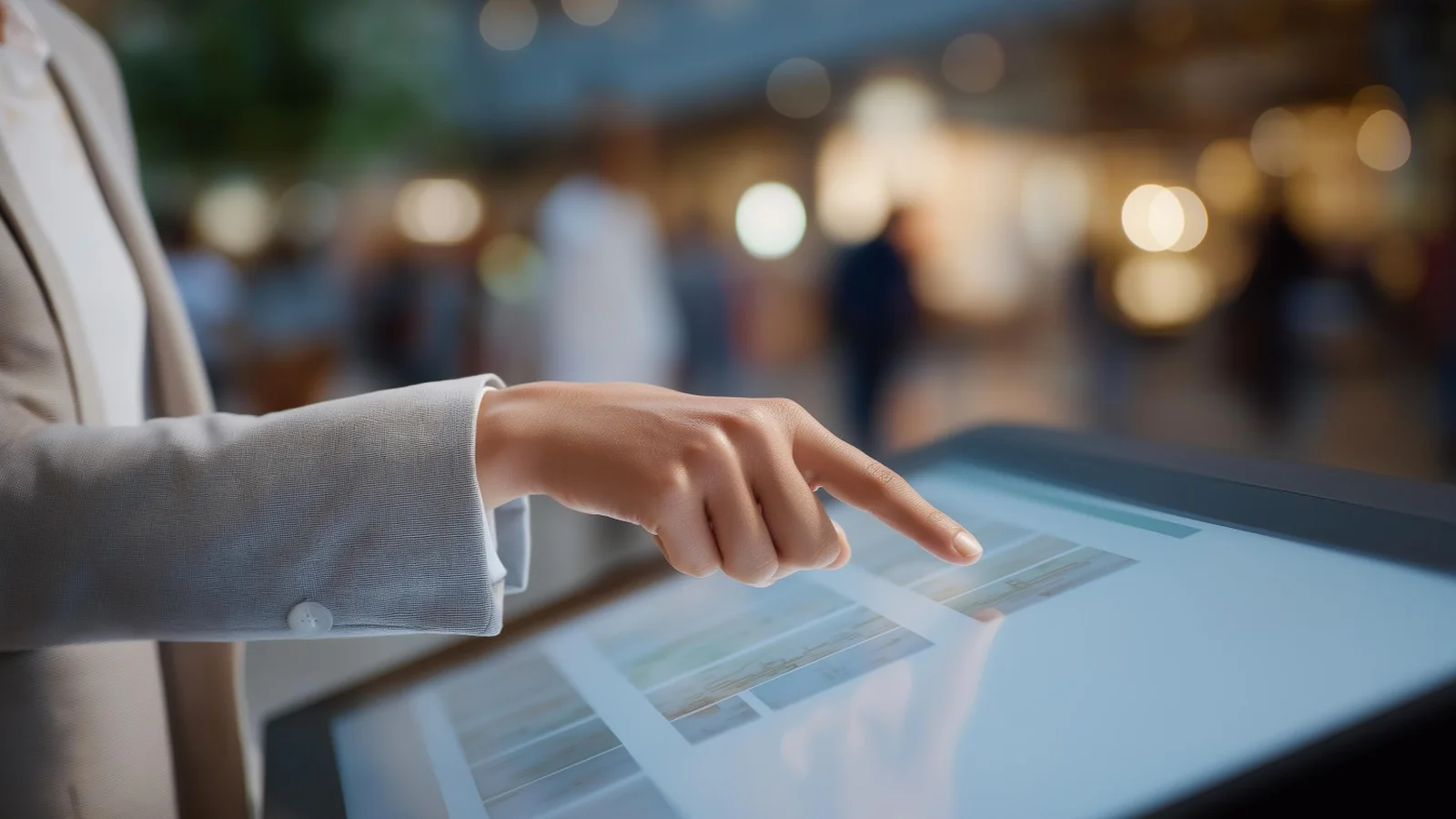
As AI, voice interfaces, biometrics, QR codes and mobile technologies reshape self-service, some have questioned whether the touchscreen is becoming obsolete. Rather than replacing touch, AI is enabling customers to move seamlessly between voice, touch, mobile devices and biometric authentication based on the task at hand.
July 7, 2026 by Richard Slawsky — Editor, Connect Media
 ChatGPT
 Grok
Grok Perplexity
 Claude
For nearly four decades, the touchscreen has been the defining feature of self-service. Whether withdrawing cash from an ATM, ordering lunch from a kiosk, checking into a hotel or buying a train ticket, consumers have grown accustomed to tapping their way through transactions.
Today, however, AI-powered voice assistants, QR codes, biometric authentication and gesture recognition are changing the conversation. Together, these technologies have fueled speculation that the touchscreen's days are numbered.
That speculation isn't new. During the COVID-19 pandemic, many predicted that hygiene concerns would accelerate a permanent shift away from public touchscreens in favor of voice interfaces, QR codes and mobile ordering. Instead, operators largely added those capabilities alongside existing kiosks, and touchscreen deployments continued as businesses reopened and consumers returned to self-service.
The continued growth of touchscreen deployments suggests those predictions were premature. Research firm DataIntelo projects the global touchscreen kiosk market will more than double from $35.8 billion in 2025 to $82.4 billion by 2034. Those projections suggest that touchscreens are evolving alongside emerging interfaces rather than being displaced by them.
Industry experts say touch is becoming one interface among several that customers will use depending on the situation. Rather than choosing between touch, voice or mobile, the next generation of kiosks and ATMs will increasingly combine them.
"It's not quite disappearing — it's becoming one voice in a broader conversation," Clément Pévrier, marketing and innovation director at Acrelec, said in an email interview. Acrelec is a global provider of self-service kiosks, digital ordering, drive-thru and restaurant automation technologies for quick-service restaurants.
"Touch is being joined by other modalities, each suited to a different context," Pévrier said.
From a single interface to many
One example of how interfaces are evolving is Proto Hologram. The company's AI-powered holographic assistants are beginning to appear in airports and other public spaces.
Raphael Kryszek, Proto's chief product and AI officer, believes the industry is moving beyond thinking about touchscreens as the primary interface.
"Touchscreens defined kiosks because they gave businesses a flexible interface," he said in a phone interview. "But the next generation of kiosks will be defined not so much by a single interface, but the orchestration of interfaces. They'll be multimodal."
The difference today is that advances in generative AI have made these interfaces dramatically more useful. Previous voice systems relied on rigid command structures that often frustrated users. Modern AI systems understand natural language, maintain conversational context and determine when to transition users from one interface to another. Rather than replacing existing interfaces, AI increasingly acts as the conductor, determining which interaction method best fits a customer's intent at each stage of a transaction.
Instead of forcing users through rigid menu trees, AI allows interactions to begin naturally. A traveler walking through an airport doesn't necessarily know which menu contains nearby restaurants. Instead of navigating layers of options, they simply say, "I'm hungry."
The system responds conversationally, displays visual recommendations, transfers directions to the traveler's smartphone through a QR code and, if necessary, returns to the touchscreen to complete a payment.
"The winning systems aren't touchless," Kryszek said. "They're frictionless."
Pévrier sees the same evolution in quick-service restaurants.
"The real shift isn't 'touch vs. voice' but a move toward multimodal interaction," he said. "The customer picks whatever channel fits the moment."
That shift may ultimately define the next decade of self-service.
The strongest evidence that touchscreens aren't disappearing comes from companies deploying kiosks every day.
Grant Wycliff, president of Carolina Georgia Sound, which installs kiosks and customer-facing technology throughout the Southeast and Midwest, sees the shift with his clients.
"The operators that we work with aren't removing the touchscreen kiosks from their locations," he said in an email interview. "They're developing around them."
Restaurant brands are increasingly allowing customers to begin orders on their phones, identify themselves through loyalty apps and complete transactions at kiosks. QR code ordering and mobile handoff have become additional layers built onto existing touchscreen deployments rather than replacements.
"The new interfaces are not replacing the hardware," Wycliff said. "They are providing solutions to the gaps that touch was never great at."
That approach improves throughput while preserving a familiar interface for customers who still prefer using the screen. Those deployments highlight an important point: despite rapid advances in AI and mobile technology, touch continues to solve problems that no other interface handles quite as well.
Why touch still matters
Much of the industry's discussion focuses on the capabilities of emerging technologies. Less attention is paid to the reasons touchscreens became dominant in the first place and remain relevant.
Touch is fast, inexpensive and familiar. It works in noisy environments where voice recognition struggles. It doesn't require customers to own smartphones or trust biometric systems. It doesn't depend on adequate lighting for cameras or a reliable internet connection for QR codes.
Privacy also matters. Speaking an order aloud in a crowded restaurant isn't always desirable. Entering it on a touchscreen often feels more comfortable.
Visual tasks remain another strength. Browsing a menu, comparing products or customizing an order is frequently easier by tapping images than describing every option verbally.
"Tapping a burger image with modifiers is often faster than verbally describing 'a burger with extra bacon, no onions, medium fries and a Coke Zero'," Pévrier said.
Perhaps most importantly, touch has become second nature. Decades of experience using smartphones, ATMs and kiosks have created habits that customers don't abandon simply because new technologies become available.
Accessibility a key driver of multimodal design
Accessibility is another reason multimodal interfaces are gaining traction. No single interaction method works equally well for every user or every situation.
Voice can make kiosks easier to use for people with visual impairments or customers whose hands are full, while touchscreens often provide a better experience for users with speech impairments or those who prefer visual navigation. Large, high-contrast buttons can benefit older adults and users with limited dexterity, and biometric authentication can simplify transactions for people who struggle to remember passwords or PINs.
Rather than replacing one interface with another, multimodal systems allow customers to choose the interaction method that best matches their individual needs and abilities.
"Touch remains the reliable fallback," Pévrier said. "It's the modality that works when the environment is noisy, when privacy matters, when speed and simplicity matter, or when a customer simply doesn't trust or want the alternative."
Mark Friend, director at education IT service provider Classroom365, sees a parallel in schools.
When touchscreen tablets entered classrooms, many predicted keyboards would disappear. Instead, students adopted whichever tool best fit the task. They might read on a touchscreen but switch to a keyboard when writing a paper.
"The greatest danger for companies is not that touchscreens are going to become extinct," Friend said in an email interview, "But rather, that they may put too much reliance upon only one type of technology."
Consumers already behave similarly. They naturally switch between smartphones, touchscreens, voice assistants and biometric authentication depending on what is most convenient in a given moment.
The challenge for operators is designing systems flexible enough to support those choices.
AI making interfaces work in partnership
Generative AI may ultimately be the technology that ties everything together.
Instead of replacing touchscreens, AI allows interfaces to become conversational while determining when another interaction method makes more sense.
Syed Rafay Hussain, a front-end developer at software development firm Cubix, describes this as the transition from a "screen-only" era to a multimodal one.
"The future belongs to the integrated industry of the kiosks," he said. "One can begin a transaction by voice command, verify through biometrics, pay through mobile payments, and meanwhile, the touch screen becomes the stage where everything takes place."
ATMs are following the same path. Financial institutions continue introducing cardless withdrawals, mobile authentication and biometric security at ATMs. A customer may authenticate through a banking app, verify identity with facial recognition or a fingerprint, and then use the touchscreen to select an account, choose denominations or request a receipt.
Yet nearly every ATM still includes a touchscreen because customers value visual confirmation when money is involved. Rather than eliminating touch, digital banking has simply redistributed it to the parts of the transaction where visual confirmation and customer control are most valuable.
The touchscreen has become one component of a broader authentication and transaction ecosystem rather than the entire experience. That same model is spreading across restaurants, retail, airports, healthcare and hospitality.
The future belongs to choice
Voice will become more conversational. QR codes will continue connecting physical and digital experiences. Biometrics will simplify authentication. AI will make kiosks feel less like machines and more like assistants. But none of those technologies solves every problem. Each performs exceptionally well in some situations and less effectively in others.
For years, the industry asked whether touchscreens would survive the arrival of AI, voice and smartphones. The better question may be why only one interface was ever expected to handle every interaction.
The future of self-service belongs to systems intelligent enough to know when customers want to tap, when they want to talk and when they simply want to keep walking.
"The bottom line is that each channel solves a specific friction point, but none solve all of them at once," Pévrier said. "Rather than a 'death of touch,' we're heading toward interfaces that let customers move fluidly between touch, voice, gesture, and QR depending on context, with touch staying the dependable common denominator."
That may ultimately be the biggest lesson for the self-service industry. The future isn't touchless. It's multimodal. And in that future, the touchscreen isn't disappearing; it's becoming one of several intelligent ways customers interact with machines.
About Richard Slawsky
In addition to writing, Slawsky serves as an adjunct professor of Communication at the University of Louisville and other local colleges. He holds both a Bachelor’s and a Master’s degree in Communication from the University of Louisville and is a member of Mensa and the National Communication Association.
Included In This Story

ACRELEC
ACRELEC is a global technology company focused on reinventing the customer experience for restaurant and retail brands. Leveraging decades of software, hardware, and service expertise, we develop and integrate new platforms that increase customer engagement, optimize efficiency, and improve operations.
Related Media
Subscribe
Get the latest news and resources from Kiosk Marketplace.