Government
Kiosks helping courts close the justice gap
Many Americans have found themselves shut out of the legal system, whether that be for cost, a lack of knowledge or the intimidation of trying to navigate unfamiliar territory. Courthouse kiosks are helping to change that by providing access to basic legal functions.
April 21, 2026 by Richard Slawsky — Editor, Connect Media
 ChatGPT
 Grok
Grok Perplexity
 Claude
For millions of Americans, the legal system remains out of reach; not necessarily because they lack legal problems, but because they lack the resources or confidence to address them.
Low-income Americans receive inadequate or no legal help for 92% of their civil legal problems, according to the Legal Services Corporation's 2022 "Justice Gap" report, and many simply avoid the system altogether due to cost or intimidation.
Even when people do seek help, legal aid organizations are forced to turn away about 49% of eligible applicants due to limited resources. The access issue is nearly as significant among Americans with higher incomes, with many attempting to resolve legal issues without professional help or taking no action at all.
Against this backdrop, self-service kiosks in courthouses and community locations are emerging as a practical, scalable solution to help close that justice gap.
Overcoming courthouse staffing shortages
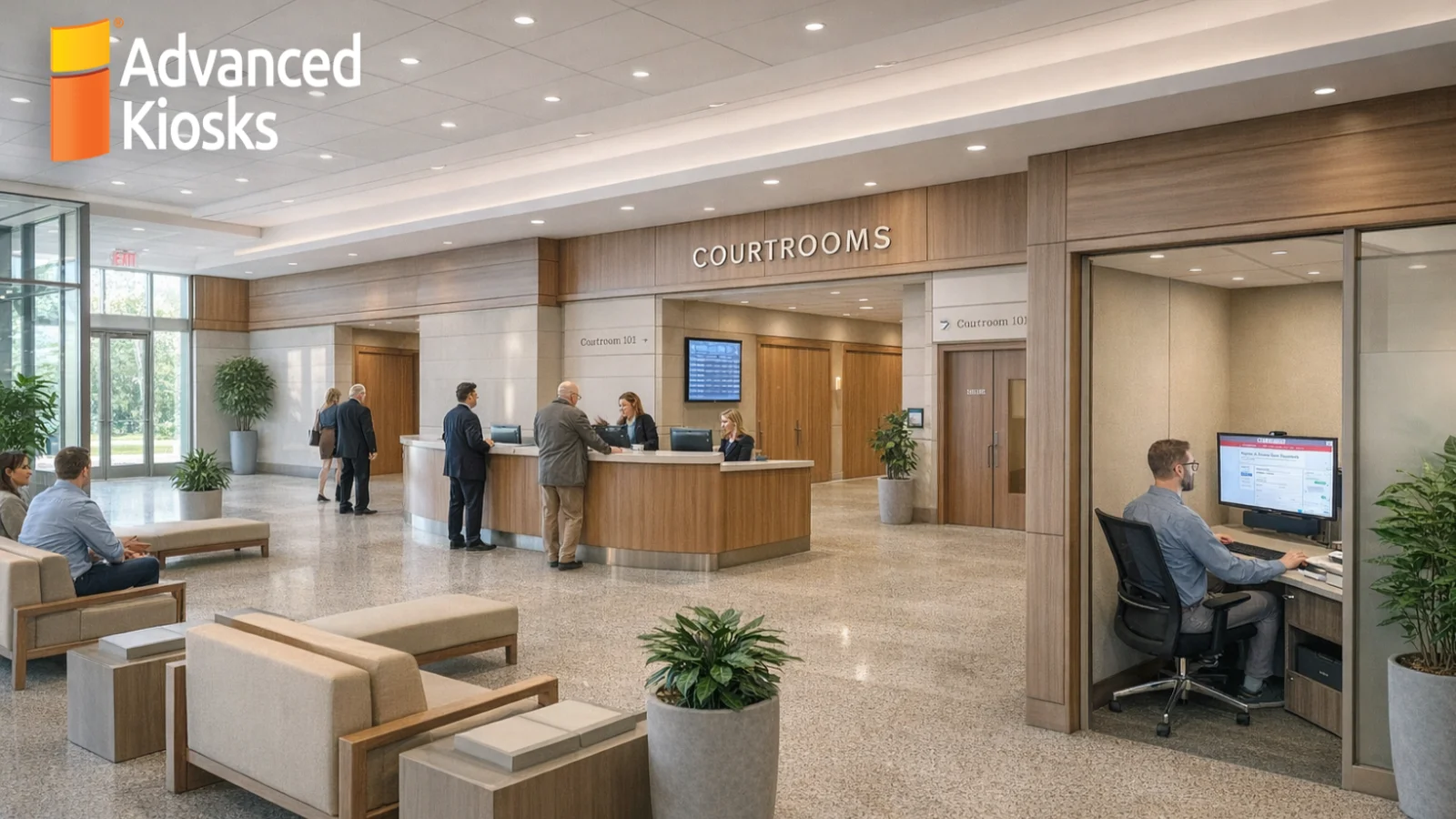
At their core, courthouse kiosks are designed to simplify access to legal information and services, providing guided, touchscreen access to court websites, legal forms and support tools. The devices often include scanners and printers, allowing users to complete and submit documents on-site.
Indiana, for example, has deployed 150 self-service kiosks statewide, one in each of its 92 counties, to provide access to forms, instructional videos, legal aid referrals, and even calendars of free legal clinics. The kiosks are part of a broader effort to address attorney shortages, rural access gaps and similar issues. State leadership has described the program as a first-in-the-nation model integrated into the court system's long-term strategy.
In Texas, the nonprofit Texas Legal Services Center has deployed 45 kiosks in government facilities around the state. The project began as a way to help Texans without reliable internet or devices attend virtual court hearings and has expanded into an access-to-justice initiative. Using the kiosks, state residents can upload legal documents, access legal aid and connect with attorneys at no cost.
And in Prince William County, Virginia, officials partnered with Concord, New Hampshire-based Advanced Kiosks to provide three self-service kiosks at Prince William County government buildings and libraries. The kiosks offer access to Circuit Court Clerk services including marriage licenses, deed copies, case information, payments and more. Officials have secured grant funding for an additional 11 kiosks.
"Kiosks in courthouses are an extremely valuable addition to the legal process," Tom Simeone, trial attorney and adjunct professor of trial advocacy at the George Washington University Law School in Washington, D.C., said in an email interview.
"People arriving for court — particularly people without a lawyer — often have no idea where to go when they arrive at court and are usually intimidated and afraid of going to the wrong place," Simeone said. "Due to budgetary constraints, only so many people can be available at a help desk, so kiosks fill a vital role by guiding many people — including lawyers — to the right place at the right time. That reduces stress and eliminates delays — both of which are vital contributions to the efficiency of the judicial process."
Addressing the digital divide
The issue of access to justice is exacerbated by technology gaps across the U.S. Despite the penetration of broadband Internet over the past decade, industry sources estimate that in 2025, nearly 26 million Americans lacked access to fixed broadband service.
Additionally, the Pew Research Center estimates a similar number, about 9% of U.S. adults, do not own a smartphone. Unsurprisingly, that number is concentrated among seniors and lower-income populations.
As courts have shifted more services online, accelerated by the COVID-19 pandemic, these gaps have become even more consequential.
Without access to technology, many individuals are effectively shut out of filing claims, accessing court records, or even understanding their legal options. Kiosks provide a physical access point that levels the playing field, allowing users to connect to the same online systems available to more affluent populations.
Beyond basic access, kiosks support a wide range of practical legal tasks. Depending on the jurisdiction, users can file small claims cases, apply for permits, pay fines and fees, check in for probation appointments, and retrieve court records.
"You don't need a $400-an-hour professional to process a simple traffic ticket, an uncontested divorce or a basic name change," James Shaffer, managing director of the online insurance comparison platform Insurance Panda, said in an email interview.
Kiosks just strip the friction out of a bloated system, Schaffer added.
"People always bring up the risk of someone clicking the wrong button and ruining their case," he said. "Have you ever watched a normal person try to fill out a 15-page court petition by hand? It's a disaster."
Advanced Kiosks' Kiosk Office Suite addresses that concern, for example, by guiding users them through the processes of filling out forms, scanning paperwork, submitting documents, looking things up and checking in. An eForms Assistant helps with each field, flagging errors before submission and answering frequently asked questions in plain language. AI functionality is enhancing those capabilities.
"AI makes this smarter by understanding what people are trying to accomplish and guiding them more intelligently," Advanced Kiosks Founder and President Howard Horn said in an email interview. "The result is accurate, complete data entering the system from the start — fewer rejections and faster processing for court staff."
Access to justice for self-represented litigants remains a central challenge for courts, with growing demand for services and limited resources straining the system, according to the National Center for State Courts.
Directing the workflow
Clerks and administrative personnel often serve as de facto guides for self-represented litigants, answering basic questions and helping individuals navigate forms and procedures. This can consume significant time and resources, particularly in high-volume courts.
By automating routine tasks such as providing forms, answering frequently asked questions, or processing payments, kiosks free up staff to focus on more complex responsibilities. This not only improves efficiency but also enhances the overall user experience by reducing wait times and streamlining interactions.
At the Itasca County Justice Center in Minnesota, Advanced Kiosks deployed similar technology at the sheriff's department to handle gun registrations and other administrative forms. The department processed more than 300 forms through the kiosks in their first 90 days of operation.
"Front desk traffic dropped substantially, and staff reclaimed hours each week," Horn said. "Records Deputy Amber Kallaus noted the old system meant constant battles with illegible handwriting and incomplete submissions. The kiosk eliminated that entirely."
Outside the normal 9-to-5
Another key advantage is expanded availability. Traditional court services are typically limited to standard business hours, which can be a barrier for individuals who work during the day or lack transportation.
Prior to the Prince William County deployment, taking a full day off work was often the only way to complete court or licensing tasks. Those without reliable transportation faced hours on public transit — as much as three and a half hours each way — just to reach the courthouse.
Kiosks, however, can be placed in accessible locations such as courthouse lobbies, libraries, or community centers, many of which offer extended hours. In some cases, kiosks are available outside normal court operations, allowing users to complete tasks at their convenience. This flexibility is particularly valuable in rural or underserved areas, where access to legal services may already be limited.
When considering an effort as significant as reshaping courthouse operations with technology, the most difficult part of the process is knowing where to begin.
Horn recommends court systems begin with their most painful use case. Solve that first, get results and expand from there.
"If your court is struggling with long lines for bill payment, especially the headache of managing cash, form rejections or unrepresented litigants stuck on paperwork, self-service kiosks are worth exploring," he said. "The only question is which pain point you want to solve first."
Courthouse kiosks may not be a replacement for attorneys or comprehensive legal aid, but they can be an essential tool in addressing the vast unmet need for legal services. By providing accessible, user-friendly entry points into the legal system, they empower individuals to take control of their legal issues, reduce strain on court resources, and extend the reach of justice to those who need it most.
About Richard Slawsky
In addition to writing, Slawsky serves as an adjunct professor of Communication at the University of Louisville and other local colleges. He holds both a Bachelor’s and a Master’s degree in Communication from the University of Louisville and is a member of Mensa and the National Communication Association.
Related Media
Subscribe
Get the latest news and resources from Kiosk Marketplace.
Recent Posts