Customer Experience
Telehealth kiosks: Extending healthcare access, lowering costs
Access to healthcare is becoming increasingly difficult in many rural communities across the United States. The issue is particularly challenging when it comes to delivering health care in rural areas. Telehealth kiosks are helping to fill the gap.
June 2, 2026 by Richard Slawsky — Editor, Connect Media
 ChatGPT
 Grok
Grok Perplexity
 Claude
Access to healthcare is becoming increasingly difficult in many rural communities across the United States.
The issue is particularly challenging when it comes to delivering health care in rural areas, away from state-of-the-art medical facilities. About 60 million people, or approximately 20% of the U.S. population, live in areas the Census Bureau considers rural.
Those areas are facing a potential health care crisis. Over the past 15 years, 182 rural hospitals, or 10% of those operating, have either closed or converted to models that no longer provide inpatient care. According to a study by The Chartis Center for Rural Health, nearly half of those remaining are operating at a loss, and 432 are at risk of closure.
The figures are just as grim when it comes to doctors. There are only about half as many doctors per capita in rural areas as in urban areas, and 8% of rural counties have no doctors at all.
So what are communities to do when their population loses its only health care facility? As with other services facing a labor shortage, kiosks are helping to fill the gap.
A life-threatening issue
When a hospital closes, the consequences can be far-reaching. Patients face longer travel times, delayed care and fewer preventive visits. Emergency departments in neighboring regions become overcrowded, and chronic conditions are more likely to worsen due to inconsistent follow-up.
Information from Boston University's School of Public Health shows that hospital closures are associated with poorer health outcomes and increased mortality in affected communities.
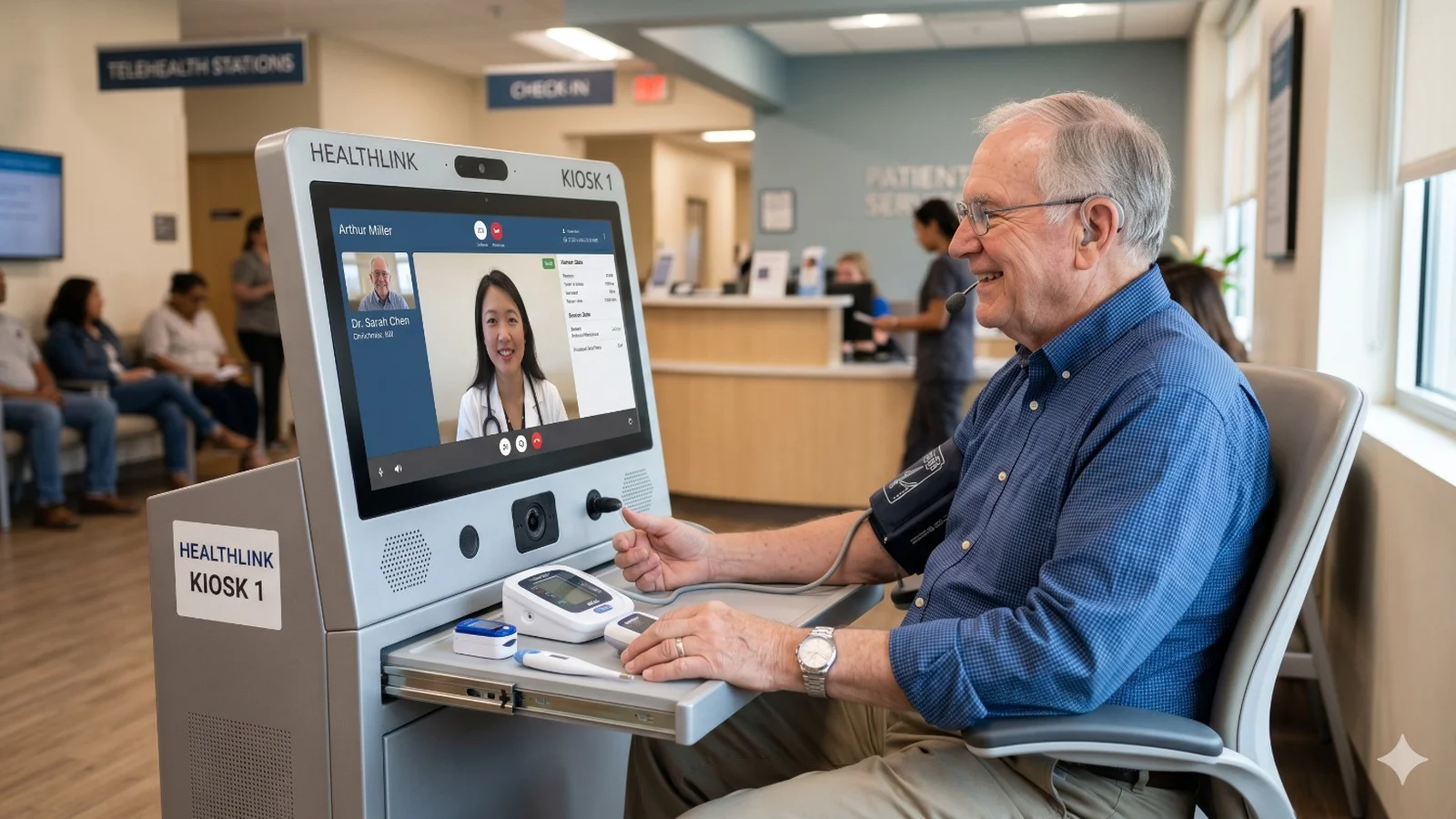
Telehealth kiosks provide access to basic care outside a full-scale facility. Placed in community centers, pharmacies, employer sites and outpatient locations, they can support routine visits, triage and follow-up consultations.
Real-world deployments are already demonstrating the potential impact of telehealth kiosks in rural communities. In 2025, Webb County, Texas, installed an OnMed CareStation telehealth kiosk in Bruni, a town of fewer than 800 residents with no practicing physicians. The kiosk allows residents to consult with licensed clinicians, complete basic health assessments and receive care without traveling nearly an hour to the nearest city.
"Improving access to care in the most needed corners of America is crucial and possible," said OnMed CEO Karthik Ganesh in a press release announcing the deployment. "The OnMed CareStation is already making a huge difference in many underserved communities across America, and we're excited by the impact it will have here."
Local officials said the station also serves several neighboring communities, helping expand access to healthcare in an area where physician shortages have long limited treatment options.
"In rural communities, these kiosks really shine; they give patients privacy and a direct line to doctors and specialists who would otherwise be out of reach," said Dr. Kamaljit K Tiwana, a dedicated clinical research professional and executive director of CCRPS, a provider of advanced clinical research training courses and certification.
"I remember working with a small town clinic that installed a kiosk in their pharmacy," he said in an email. "Suddenly, people were coming in for regular checkups and not waiting until a problem became urgent."
Easy access encourages preventive screenings and chronic disease check-ins, reducing the risk of costly complications.
"We see medical outcomes improve when a patient interacts with a screen in their own town instead of delaying medical care for months," Cassidy Blair, a licensed clinical psychologist and founder of Beverly Hills, California-based Blair Wellness Group, said via email. "That's why these stations serve as a lifeline for areas that don't have a physical doctor presence."
Those benefits are reflected in lower out-of-pocket costs for patients. Although not kiosk-specific, research published by the American Medical Association analyzing more than 25,000 telehealth visits found that average patient cost savings ranged from about $147 to $186 per visit, accounting for travel time, lost productivity and mileage costs.
At the same time, telehealth kiosks can offer similar cost benefits for both health care providers and insurance companies. A study published by the National Library of Medicine found that telehealth can reduce total service costs; for example, total service cost savings of $24,352 over a 7-month period for specialist telehealth cases compared with conventional care. Other research indicates that telehealth interventions have reduced hospital emergency department costs by more than 30%.
"Cost reductions happen through telehealth kiosks because the local emergency room will no longer sustain the financial losses incurred by treating non-emergent conditions like conjunctivitis," Chris Kirksey, founder and CEO of Austin, Texas-based Direction.com, a digital marketing and SEO agency that focuses on the healthcare industry, said in an email interview.
"Telehealth kiosks make it possible for one physician to serve multiple locations within the same period, so healthcare systems evaluating how to maintain their financial viability in small communities can achieve better potential outcomes," Kirksey said. "Our analysis revealed that a rural health network implemented kiosks for patients to access low-cost, walk-in medical care and that there was a 34% decrease in emergency department visits for non-urgent reasons in those three locations."
Challenges and adoption considerations
Despite their promise, telehealth kiosks are not a universal or plug-and-play solution for healthcare delivery. Although the technology itself is relatively mature, successful adoption depends far more on how kiosks are implemented and integrated than on the hardware alone. Health systems that treat kiosks as standalone devices or experimental pilots often struggle to achieve sustained utilization or measurable impact.
First, clear clinical protocols are essential. Telehealth kiosks work best when there is a clear understanding of which conditions for which they are appropriate, which patients should be directed to them and how clinicians are expected to interact during kiosk-based visits. Without standardized protocols, kiosks can cause confusion for both patients and providers, limiting their usefulness.
Second, integration with existing healthcare systems is critical. Telehealth kiosks must connect seamlessly with scheduling platforms, administrative workflows and electronic health records. When kiosks exist outside those platforms, they increase administrative burden, add to the possibility of recordkeeping errors and risk fragmented care.
Third, patient education and trust-building play a significant role in adoption. Many patients, particularly older adults or those with limited digital literacy, may be unfamiliar or uncomfortable with kiosk-based care. Clear signage, simple user interfaces, and access to live assistance can help demystify the technology.
Fourth, ongoing measurement of utilization and outcomes is critical to justifying continued investment. Health systems must continuously monitor utilization, outcomes and operational performance. Tracking metrics such as avoided emergency department visits, patient satisfaction and follow-up compliance helps justify investment, while regular maintenance, software updates and staff training help ensure kiosks remain reliable and trusted by patients and clinicians.
Finally, it's important to note that kiosks aren't a one-size-fits-all solution. In most cases, doctors are limited in the types of medications they can prescribe, and in some cases, there's no substitute for a face-to-face visit.
"Technology is still not capable of the tactile feedback I require in an in-depth physical diagnostic exam," Blair said. "These kiosks work best for simple routines and triages, but they are inadequate when patients need complex medical interventions."
A growing role in the self-service healthcare ecosystem
As hospital closures continue and health care systems seek ways to maintain access, telehealth kiosks are likely to play an increasingly important role in care delivery strategies. For the kiosk industry, this represents a meaningful expansion beyond retail and ticketing into mission-critical healthcare infrastructure.
Telehealth kiosks are unlikely to replace hospitals or physician offices. But as rural communities confront shrinking healthcare resources, the technology offers providers a way to extend care beyond traditional facilities and bring basic services closer to the patients who need them most.
About Richard Slawsky
In addition to writing, Slawsky serves as an adjunct professor of Communication at the University of Louisville and other local colleges. He holds both a Bachelor’s and a Master’s degree in Communication from the University of Louisville and is a member of Mensa and the National Communication Association.
Related Media
Subscribe
Get the latest news and resources from Kiosk Marketplace.
Recent Posts