Government
Cities betting big on smart kiosks
The pace of smart city kiosk deployments appears to be increasing in the United States as cities accelerate investments in digital infrastructure, downtown revitalization, public Wi-Fi and more.
May 19, 2026 by Richard Slawsky — Editor, Connect Media
 ChatGPT
 Grok
Grok Perplexity
 Claude
From New York to Seattle, cities are betting smart kiosks can modernize public infrastructure and improve communication with residents and visitors while generating millions in advertising revenue. The pace of smart city kiosk deployments appears to be increasing in the United States as cities accelerate investments in digital infrastructure, downtown revitalization, public Wi-Fi and more.
One market study projects the smart city kiosk industry will grow at a 16.9% compound annual rate over the next 10 years, reaching $101.4 billion by 2035 from $21.2 billion in 2025.
Once viewed primarily as digital advertising displays or tourist wayfinding tools, smart city kiosks have evolved into multifunction public infrastructure platforms capable of supporting transportation systems, emergency communications, tourism initiatives, economic development and digital equity programs. As urban areas continue investing in connected technologies, smart kiosks are becoming an increasingly visible part of the modern streetscape.
Companies such as IKE Smart City, Intersection and JCDecaux have expanded deployments across major metropolitan areas, placing interactive kiosks in downtown districts, transportation corridors, entertainment areas and tourism centers. Recently announced smart city kiosk projects include ones in Austin, Texas; Charlotte, North Carolina and Culver City, California.
With all that in mind, are smart city kiosks delivering on their promise? So far the answer appears to be yes, with a few caveats.
The revenue equation
One of the biggest advantages for municipalities is the ability to generate recurring revenue through digital advertising. Many smart city kiosk deployments operate under public-private partnership models in which the kiosk provider installs and maintains the infrastructure while sharing advertising revenue with the city.
That revenue can become significant in high-traffic urban environments. Municipal leaders increasingly view those systems as a way to fund public services and infrastructure improvements without placing additional burdens on taxpayers.
The largest smart city kiosk deployment is New York's LinkNYC, which includes more than 2,200 kiosks serving millions of residents and visitors. The kiosks offer free Wi-Fi, nationwide calling, device charging and access to 911 and government services.
According to a 2025 report from operator CityBridge, LinkNYC kiosks generated more than $125 million in revenue for New York City between 2015 and the end of 2024. Additionally, the deployment has supported more than $1.3 billion in economic activity over that time, the report claims, providing 655 jobs and more than $98 million in labor income. CityBridge is a joint venture between out-of-home media and technology company Intersection and wireless infrastructure provider Boldyn Networks.
In Dallas, a contract between the city and IKE Smart City LLC to install up to 150 digital kiosks on city sidewalks is projected to generate approximately $67 million in revenue over 10 years.
And in Seattle, downtown business groups expect the city to take in roughly $1.1 million in advertising revenue annually from an initial deployment of 30 kiosks planned ahead of the 2026 FIFA World Cup. The city expects to eventually place as many as 80 kiosks throughout the downtown area.
Still, city officials and industry observers emphasize that smart city kiosks offer benefits that extend well beyond advertising.
"In New York City, smart kiosks are evolving beyond basic information points to become multifaceted hubs that support commerce, public Wi-Fi, and real-time transit updates," said Daniel Park, markets editor for nycbusinesspulse.com, in an email interview. Park tracks how the city integrates technology into urban infrastructure.
"Their deployment reflects a broader trend where municipalities leverage data-driven solutions to improve urban mobility and local business visibility," Park said. "From a commercial real estate perspective, kiosks influence foot traffic patterns and can enhance the value proposition of retail corridors by driving consumer engagement in high-density neighborhoods."
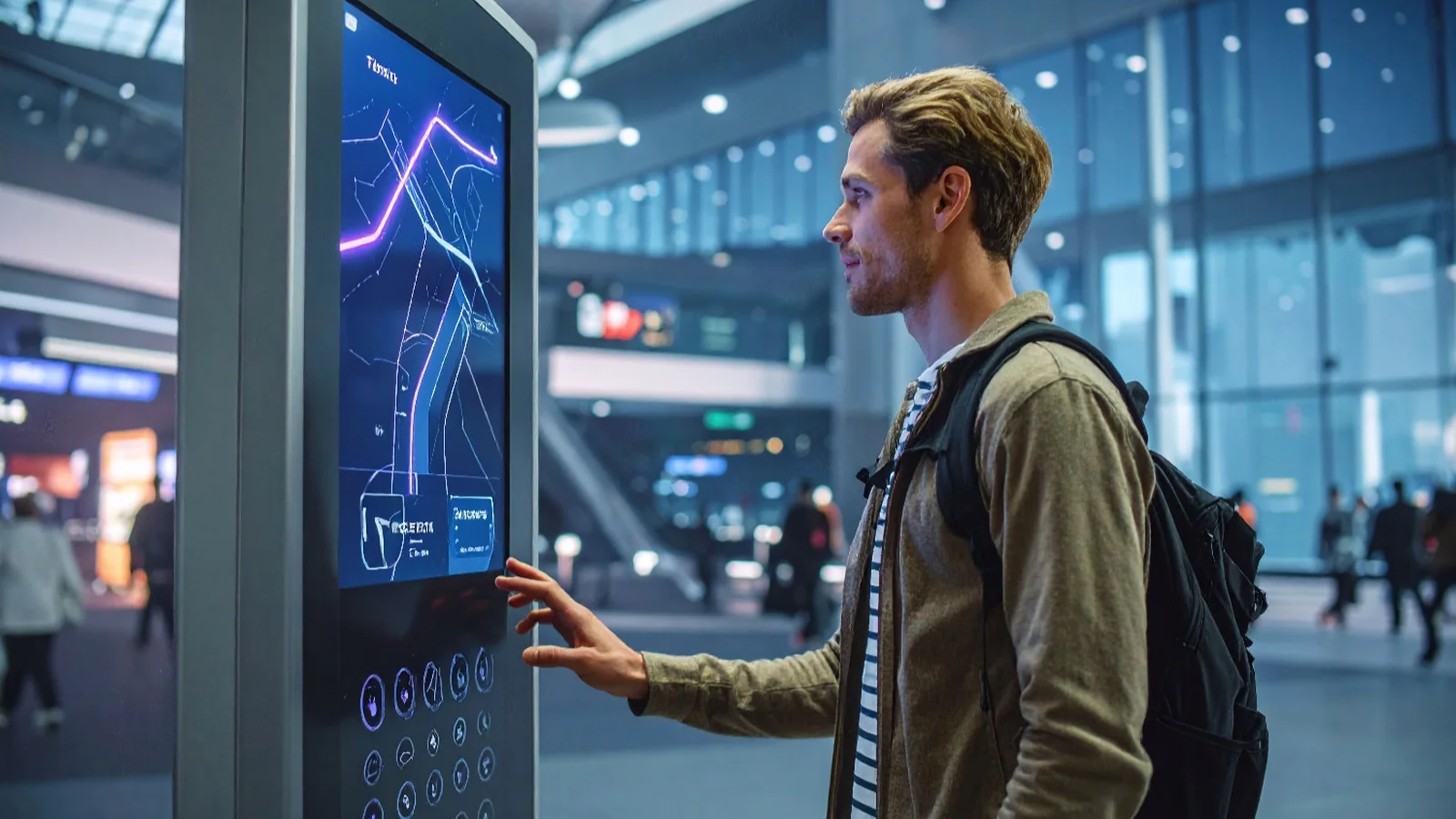
Wayfinding and tourism support remain among the most visible public-facing functions. Interactive kiosks can provide real-time maps, restaurant listings, event calendars, public transit information and directions to nearby attractions. For visitors unfamiliar with a city, the kiosks effectively serve as digital concierges placed directly on sidewalks and in public gathering areas.
Tourism and convention districts particularly benefit from those capabilities. Cities hosting major events often use smart kiosks to direct pedestrian traffic, highlight nearby businesses and provide real-time updates on transportation or event schedules.
"While at Pestana Hotel Group, we monitored the ways in which guests found our hotels once they reached a new city," said Rui Martins in an email interview. Martins is the co-founder of digital marketing agency Smartlinks and the former director of online sales at Pestana Hotel Group, overseeing digital distribution for more than 50 hotels in Europe and America.
"The trend was the same. Individuals relied on the information source that was most convenient and readily available," he said. "Kiosks are the right tool to engage visitors at the right time, and that's when every hotel and attraction wants to be there."
Public safety and emergency communication capabilities are another major selling point for municipalities. Smart kiosks can quickly display emergency alerts, weather warnings, evacuation information and Amber Alerts across entire urban districts.
During major public events or emergencies, those systems provide cities with an additional communication channel that reaches pedestrians directly in public spaces. Some kiosks also include emergency call buttons, security cameras or direct connectivity to public safety agencies.
Revenue and privacy concerns remain
Digital equity initiatives are also becoming closely tied to smart kiosk deployments. Many systems provide free public Wi-Fi access, device charging and connectivity services in areas where broadband access may be limited.
As internet access becomes increasingly essential for employment, education, healthcare and government services, some municipalities view public connectivity infrastructure as a civic necessity rather than a luxury. Kiosk-based Wi-Fi systems can help expand internet access without requiring major new physical infrastructure projects.
Economic development agencies likewise see smart kiosks as tools to support local businesses. Interactive directories and neighborhood maps can steer visitors toward nearby restaurants, retailers and entertainment venues, increasing visibility for small businesses that may otherwise struggle to attract tourist traffic.
Still, there have been cases where smart city kiosks didn't quite live up to the hype. In New York, for example, LinkNYC kiosks were projected to deliver $500 million in guaranteed revenue in the first 12 years of the program. Although specific figures weren't released, a 2021 audit of the program by the New York State Comptroller's Office "identified significant shortfalls, in terms of both revenue to the City and services."
And in Berkeley, California, Orange Barrel Media told the city in its 2018 contract negotiations that each of its 31 proposed IKE Smart City kiosks would generate more than $26,000 in revenue each year. Instead, in 2024 the kiosks generated an average of $4,967 each. In an article by local media outlet Berkeleyside, Orange Barrel officials blamed the figures on the slow economic recovery from the pandemic and a technology sector that has cooled significantly over the past several years.
Privacy concerns have arisen as an issue as well. A 2025 report from the U.S. Government Accountability Office warned that smart city technologies collect large amounts of potentially sensitive personal data and may create "privacy and civil liberties concerns" if information is sold, shared or insufficiently protected. The report noted that many smart city systems rely on continuous collection of behavioral and location data.
"Research has found that smart technology data may be used to identify individuals, which increases the potential for scams and can result in economic harms such as increased insurance costs," the report authors wrote. "Experts stated that individuals should ideally be able to consent to use of their data. However, absent conditions for individuals to provide consent, local elected representatives may have a role in approving the use of smart technologies that collect data on individuals."
And academic research published in 2025 highlighted concerns about smart city kiosks with integrated cameras, Wi-Fi systems and environmental sensors. Researchers warned that such systems can create data privacy and surveillance risks, particularly when combined with behavioral analytics and location tracking.
"Kiosks gather various data streams, including sensitive information like pedestrian traffic and environmental conditions," Rose Ann Cordero, communications coordinator with Aware Monitoring Systems, said in an email interview. Aware develops smart city monitoring and public-safety technologies to help municipalities and organizations monitor infrastructure, traffic, environmental conditions and security events in real time.
"Compliance with privacy regulations [such as GDPR] and clear communication about data usage are essential to gain public acceptance," Cordero said. "We advocate for strategies like data anonymization and on-device processing to minimize privacy risks."
As cities continue experimenting with connected infrastructure, smart kiosks are increasingly evolving beyond static information terminals into integrated public-service hubs capable of supporting transportation, tourism, communications, emergency response and economic development.
Whether smart kiosks ultimately become essential civic infrastructure or simply digital street furniture may depend on how effectively cities balance monetization, public utility and privacy.
About Richard Slawsky
In addition to writing, Slawsky serves as an adjunct professor of Communication at the University of Louisville and other local colleges. He holds both a Bachelor’s and a Master’s degree in Communication from the University of Louisville and is a member of Mensa and the National Communication Association.
Related Media
Subscribe
Get the latest news and resources from Kiosk Marketplace.