Retail
Self-service becomes retail infrastructure
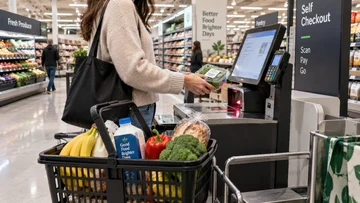
Retailers are rapidly expanding self-service technology far beyond the traditional checkout lane as they look to improve customer experience, streamline store operations and address labor shortages, according to a new report from Coresight Research.
May 26, 2026 by Richard Slawsky — Editor, Connect Media
 ChatGPT
 Grok
Grok Perplexity
 Claude
Retailers are rapidly expanding self-service technology far beyond the traditional checkout lane as they look to improve customer experience, streamline store operations and address labor shortages, according to a new report from Coresight Research.
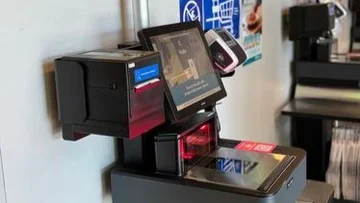
The report, "Self-Service Technology: Powering the Modern In-Store Experience and Operations," produced in partnership with Zebra Technologies and Elo Touch Solutions, surveyed 150 U.S. retail executives earlier this year and found retailers increasingly view self-service systems, including kiosks, self-checkout terminals, scan-and-go platforms and smart carts, as essential infrastructure rather than standalone convenience tools.
Moving beyond the checkout lane
One of the report's central findings is that retailers are deploying multiple self-service technologies simultaneously to support the entire shopping journey. Retailers using self-service systems now operate an average of 3.5 different self-service formats, including self-checkout terminals, smartphone scan-and-go applications, handheld scanner systems, self-ordering kiosks and smart carts equipped with digital screens.
Self-checkout remains the most widely adopted technology, with 89% of surveyed retailers using it, but adoption of newer formats is accelerating. Smartphone-based scan-and-go systems and self-ordering kiosks were each deployed by 77% of surveyed retailers, while smart carts continue gaining traction as retailers experiment with more advanced in-store experiences.
Steven Winnick, vice president at Coresight Research, said grocery and department stores are among the fastest adopters because of their high traffic levels and larger store footprints.
"These segments typically have high traffic volumes, larger format stores, frequent customer visits and larger opportunities to improve convenience throughout the shopping journey," Winnick said in an email interview.
"Retailers in these categories increasingly recognize that improving customer experience can directly drive higher basket sizes, stronger customer retention and increased loyalty. As a result, many are expanding self-service beyond checkout into broader shopper engagement and store operations."
Reducing friction across the store
The report identifies retail "friction," including checkout delays, product-search difficulties and store navigation challenges, as one of the primary drivers behind self-service investments. According to the survey, more than two-thirds of retailers reported significant friction around product discovery, pricing clarity and purchase confidence.
At checkout, 69% of respondents cited peak-hour wait times as a major challenge, while 67% pointed to front-of-store congestion and insufficient staffing. Retailers see self-service systems as a way to distribute transactions across the shopping journey rather than concentrating activity at traditional checkout lanes.
The report also emphasizes that self-service technologies are becoming customer engagement tools rather than simply transactional systems. Smart carts, kiosks and scan-and-go platforms now provide shoppers with product comparisons, loyalty integration, pricing information, recommendations and promotions while they shop.
Retailers see those digital touchpoints as opportunities to influence buying decisions in real time and increase basket size. Tesco's enhanced "Scan as You Shop" platform was cited as one example, integrating shopping lists, aisle locations and inventory information into handheld scanners connected to loyalty accounts.
Operational and labor benefits
Operational efficiency remains another major driver behind self-service adoption. Seventy percent of surveyed retailers said self-service systems improve peak-hour throughput, while 83% reported reduced front-of-store staffing requirements after deployment.
The report estimates retailers can free roughly four associates per store — equivalent to approximately 22% of front-end labor capacity and about $184,000 in annual labor value per location. Rather than eliminating positions entirely, many retailers are reallocating associates toward merchandising, fulfillment and customer assistance roles.
Winnick said retailers are not deploying self-service technology solely to reduce labor costs.
"The ROI is driven by both customer-facing and operational benefits," he said. "On the customer side, retailers are seeing improvements in convenience, customer satisfaction, basket size and loyalty. For example, 54% of grocery respondents and 65% of department store respondents reported increases in basket size following deployment."
Self-service systems are also improving inventory management and shelf visibility. Technologies such as RFID-enabled self-checkout and smart carts generate real-time inventory and transaction data that retailers can use to improve replenishment and forecasting.
Seventy-seven percent of retailers reported improved out-of-stock detection after deploying self-service systems. The report cited Decathlon as an example, noting that its RFID-enabled self-checkout deployment in Brazil increased inventory accuracy by 3% and improved inventory-counting productivity by 38%.
Shrink, integration and AI
Despite the momentum, retailers continue facing challenges around shrink, infrastructure and system integration. Forty-nine percent of surveyed retailers reported increased shrink following self-service deployments.
Still, Winnick said most retailers do not view theft concerns as a reason to abandon the technology.
"Retailers increasingly see shrink as a challenge to manage rather than a reason to avoid deployment," he said. "Most do not view it as a barrier significant enough to stop adoption and piloting the technologies."
The report argues that self-service technologies are increasingly evolving into connected retail platforms rather than isolated hardware deployments. Retailers ranked payments, barcode scanning, pricing systems, inventory management and loss prevention among the most critical integrations.
Winnick said retailers increasingly understand that self-service systems "cannot operate effectively as isolated point solutions" and instead require interoperability across broader retail technology ecosystems.
Looking ahead, the report predicts AI, RFID and computer vision technologies will further transform the self-service landscape. Winnick said self-service systems are increasingly functioning as both customer engagement tools and real-time data infrastructure.
"These technologies generate large amounts of behavioral and operational data that retailers can use to train AI models, identify operational bottlenecks and better understand customer behavior," Winnick said. "Over time, self-service systems will increasingly function as both customer engagement platforms and real-time data collection infrastructure across the store."
About Richard Slawsky
In addition to writing, Slawsky serves as an adjunct professor of Communication at the University of Louisville and other local colleges. He holds both a Bachelor’s and a Master’s degree in Communication from the University of Louisville and is a member of Mensa and the National Communication Association.
Included In This Story

Elo
Elo is everywhere
Elo delivers configurable self-service kiosk solutions for hospitality, retail, healthcare, and more. From self-order and self-checkout to visitor and patient check-in, Elo combines commercial-grade touchscreens, payment, printing and peripherals with centralized device management.

Zebra Technologies
Zebra’s scan engines for self-service kiosk solutions give customers seamless quick service technology while providing a long lifecycle they can count on.
Related Media
Subscribe
Get the latest news and resources from Kiosk Marketplace.
Recent Posts