Customer Experience
Self-checkout's labor equation goes beyond cutting cashier hours
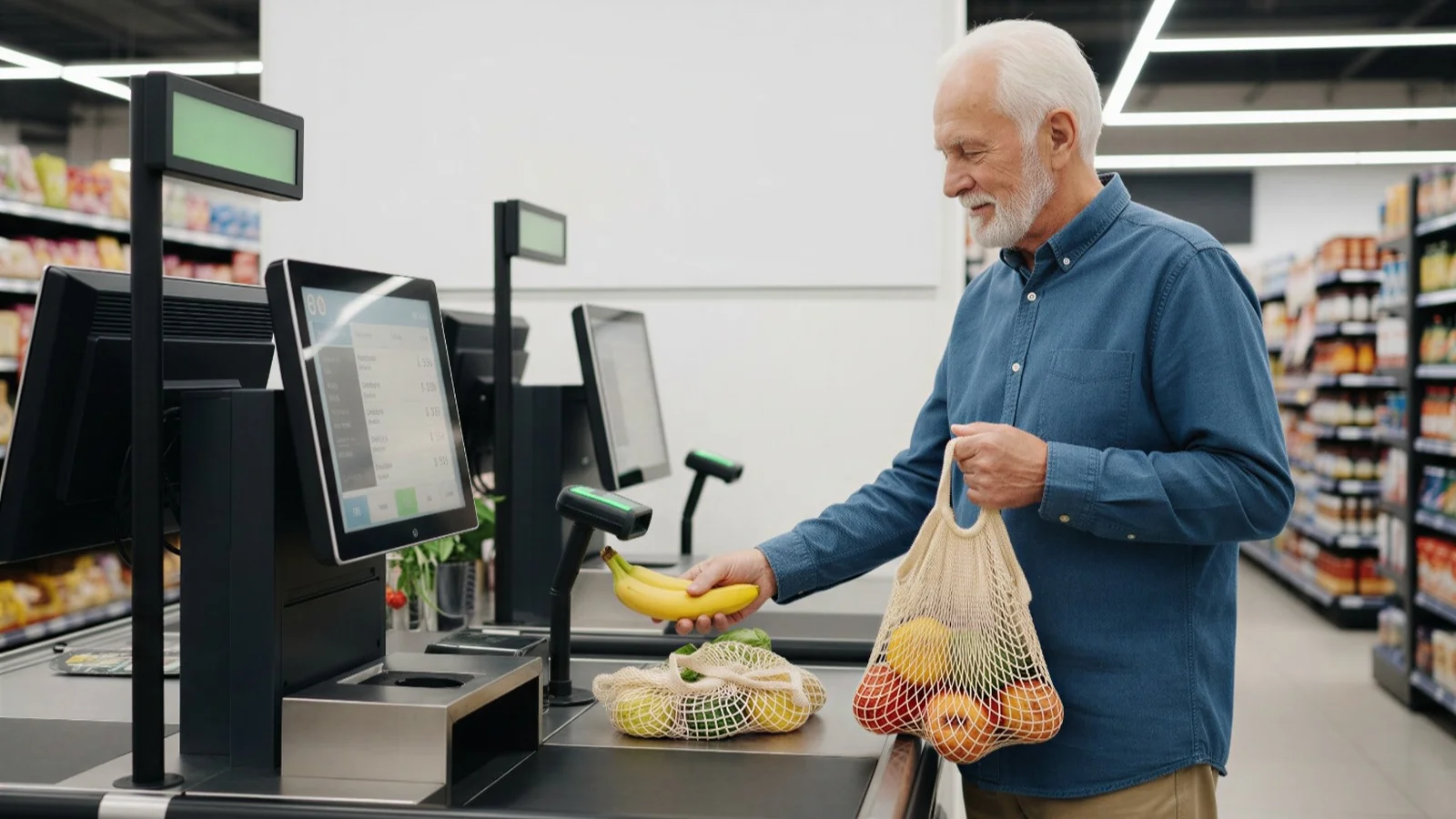
Self-checkout can reduce the labor devoted to conventional cashiering, increase the number of transactions employees can supervise and free associates for other tasks, but it also creates new work involving interventions, age verification, loss prevention and customer assistance.
August 18, 2026 by Richard Slawsky — Editor, Connect Media
 ChatGPT
 Grok
Grok Perplexity
 Claude
For years, one of the central arguments for self-checkout has been straightforward: Let customers scan and pay for their own purchases, and retailers can operate checkouts with fewer labor hours.
The reality emerging from retailers' financial disclosures, earnings calls and operational experience shows the issue to be more complicated. Self-checkout can reduce the labor devoted to conventional cashiering, increase the number of transactions employees can supervise and free associates for stocking, fulfillment or customer service. But it also creates new work involving interventions, age verification, loss prevention and customer assistance.
The experience of major retailers suggests the most useful question may no longer be how many jobs self-checkout eliminates. Instead, retailers increasingly need to determine how automation changes the work employees perform, and whether the resulting productivity gains outweigh the additional labor and losses the technology can create.
Dollar General illustrates the changing calculation
In 2022, Dollar General explicitly connected self-checkout with labor productivity. During its second-quarter earnings call, management described self-checkout as part of its Fast Track initiative, whose goals included increasing labor productivity and customer convenience. With self-checkout then available in approximately 10,000 stores, Dollar General said the technology was producing greater efficiencies for store associates.
The company subsequently expanded that strategy. Dollar General told investors in 2023 that a pilot offering self-checkout across all lanes could enable store teams to spend more time serving customers. That represents an important distinction in calculating automation's return: Labor value does not necessarily require eliminating a position. Redeploying an employee from repetitive checkout work to stocking shelves, helping customers or managing inventory can create capacity without reducing headcount.
Dollar General's later experience, however, demonstrates why those benefits cannot be considered in isolation.
In 2024, the company dramatically revised its self-checkout strategy amid concerns about shrink and the customer and associate experience. Its 2023 annual report, filed in 2024, said Dollar General planned to convert some or all self-checkout registers to assisted checkout in approximately 9,000 stores and remove self-checkout from roughly 300 locations. A subsequent quarterly filing said the company had converted some or all SCO registers to assisted checkout in approximately 12,000 stores.
The retailer also increased the employee presence at the front of stores. Management said it was redeploying labor hours toward store teams, with greater emphasis on customer service, inventory management and checkout areas.
Dollar General's experience demonstrates a central challenge in evaluating self-checkout ROI. A system can generate labor efficiencies at the transaction level while producing costs elsewhere through shrink, supervision requirements or customer-service demands.
Circle K targets labor efficiency through faster transactions
Convenience retail presents a different labor equation because stores typically operate with smaller staffs and customers place a particularly high value on speed.
Alimentation Couche-Tard, parent of Circle K, has deployed AI-powered Smart Checkout systems that recognize products through computer vision rather than requiring customers to scan individual barcodes.
During its fiscal 2024 first-quarter earnings call, then-CEO Brian Hannasch said the company was using Smart Checkout to improve store labor efficiency and the customer experience. At the time, Circle K had nearly 2,700 Smart Checkout units in about 2,200 North American stores, and approximately 40% of in-store payment transactions at those locations were passing through the automated systems. Management said the technology also made it easier for employees to concentrate on serving customers.
That model illustrates another way of viewing labor productivity: transactions per labor hour.
Rather than asking whether a kiosk replaces a cashier, retailers can measure whether the same number of employees can handle more transactions during busy periods. Technology provider Mashgin reported in a study of 65 high-volume periods across six stores that adding one of its AI checkout units to a single-cashier operation increased throughput by 150% during those periods. A cashier combined with one automated unit also produced 36% higher throughput than stores operating with two traditional cashiers, according to the company study. Because the research comes from the technology supplier, the results should be viewed as vendor-reported rather than independent research.
The potential labor benefit is particularly significant when traffic arrives in bursts. A retailer may not need to staff multiple conventional registers throughout a shift if automation can handle temporary peaks.
Redeployment may matter as much as reduction
Five Below has offered another example of how self-checkout can change employee responsibilities.
The retailer previously described assisted self-checkout as allowing employees to move out from behind the traditional cash wrap and interact with customers elsewhere in the store. But, like Dollar General, Five Below subsequently modified its approach as shrink became a greater concern.
During its second-quarter 2024 earnings call, Five Below said customers continued to value the speed and efficiency of self-checkout, but management described a shift toward associate-monitored self-checkout areas to help control shrink.
That tension highlights why labor redeployment should be measured carefully. Moving an employee from a conventional register does not automatically create savings. If that employee must remain close to self-checkout to approve exceptions, resolve scanning problems, monitor suspicious behavior and help confused customers, much of the theoretical labor capacity may disappear.
The distinction between hard labor savings and labor capacity therefore matters.
If self-checkout enables a retailer to eliminate 20 overtime hours each week, the savings can be directly measured. If it instead gives employees 20 additional hours to stock shelves or help customers, the benefit may still be substantial, but it should not be booked as payroll savings unless labor spending actually declines.
Grocery retailers cite labor supply as a factor
The relationship between checkout automation and labor extends beyond reducing costs.
Weis Markets said in its 2024 annual report that it had completed a multiyear initiative in 2023 to install or upgrade self-checkouts, including convertible dual-use checkout lanes. The grocery retailer specifically said the project was undertaken in response to customer preference and labor supply.
That points to another increasingly important rationale for automation: A retailer may use self-service not because it wants to eliminate employees, but because it cannot reliably staff every position it would otherwise require.
In that situation, the economic benefit may appear as avoided hiring, greater peak-hour capacity or the ability to maintain operating hours despite staffing constraints.
Self-checkout also creates new labor
The labor calculation becomes even more complicated once retailers account for the tasks automation creates.
Self-checkout attendants may simultaneously monitor multiple transactions, respond to unexpected-item alerts, approve restricted products, correct scanning errors, remove security tags, answer payment questions and intervene when loss is suspected. The employee has shifted from processing one transaction at a time to supervising a small network of transactions.
That can produce considerable leverage when everything works properly. It can also create bottlenecks when interventions rise.
Loss prevention adds another layer. Retailers may discover that reducing cashier labor creates a need for greater attendant coverage, security technology or other loss-prevention measures. Dollar General's retreat from widespread self-checkout demonstrates how quickly the economic equation can change when shrink becomes significant enough to offset labor efficiencies.
Automation also doesn't necessarily reduce overall labor expense. Dollar General's fiscal 2023 annual report said the company invested approximately $150 million in additional retail labor during the year. Its fiscal 2024 annual report said retail labor expenses increased as a percentage of sales in both 2023 and 2024. Although those increases cannot be attributed solely to self-checkout, they underscore the danger of assuming widespread automation automatically translates into lower companywide labor costs.
Measuring the real labor impact
The evidence suggests retailers should move beyond "cashiers eliminated" when measuring self-checkout.
A more useful scorecard would include transactions per labor hour, interventions per 100 transactions, attendant-to-kiosk ratio, overtime, checkout wait time, employee time redirected to other tasks, avoided hiring, customer abandonment and verified shrink.
Retailers also need to measure whether redeployed time actually produces value. If employees freed from checkout can replenish shelves more frequently, the result could be better product availability and additional sales. If they assist customers, the retailer could see higher satisfaction or conversion. If they simply spend more time resolving self-checkout exceptions, the projected productivity gain may never materialize.
The evolution of self-checkout at Dollar General and Five Below is particularly instructive. Both companies saw advantages in automation and labor efficiency, yet both later adjusted their strategies as they confronted shrink and supervision requirements. Circle K, meanwhile, illustrates how faster AI-assisted checkouts may produce a different equation in small-format convenience stores, where increasing throughput with limited staffing can be especially valuable.
For retailers evaluating the next generation of checkout, the labor business case ultimately comes down to a more demanding standard: not whether customers can do work once performed by cashiers, but whether automation allows the entire store to accomplish more with the labor resources available.
About Richard Slawsky
In addition to writing, Slawsky serves as an adjunct professor of Communication at the University of Louisville and other local colleges. He holds both a Bachelor’s and a Master’s degree in Communication from the University of Louisville and is a member of Mensa and the National Communication Association.
Related Media
Subscribe
Get the latest news and resources from Kiosk Marketplace.