Retail
The Intelligent Retail Edge: How Intel® Core™ Ultra Is redefining POS, self-service kiosk, self-checkout, and digital signage
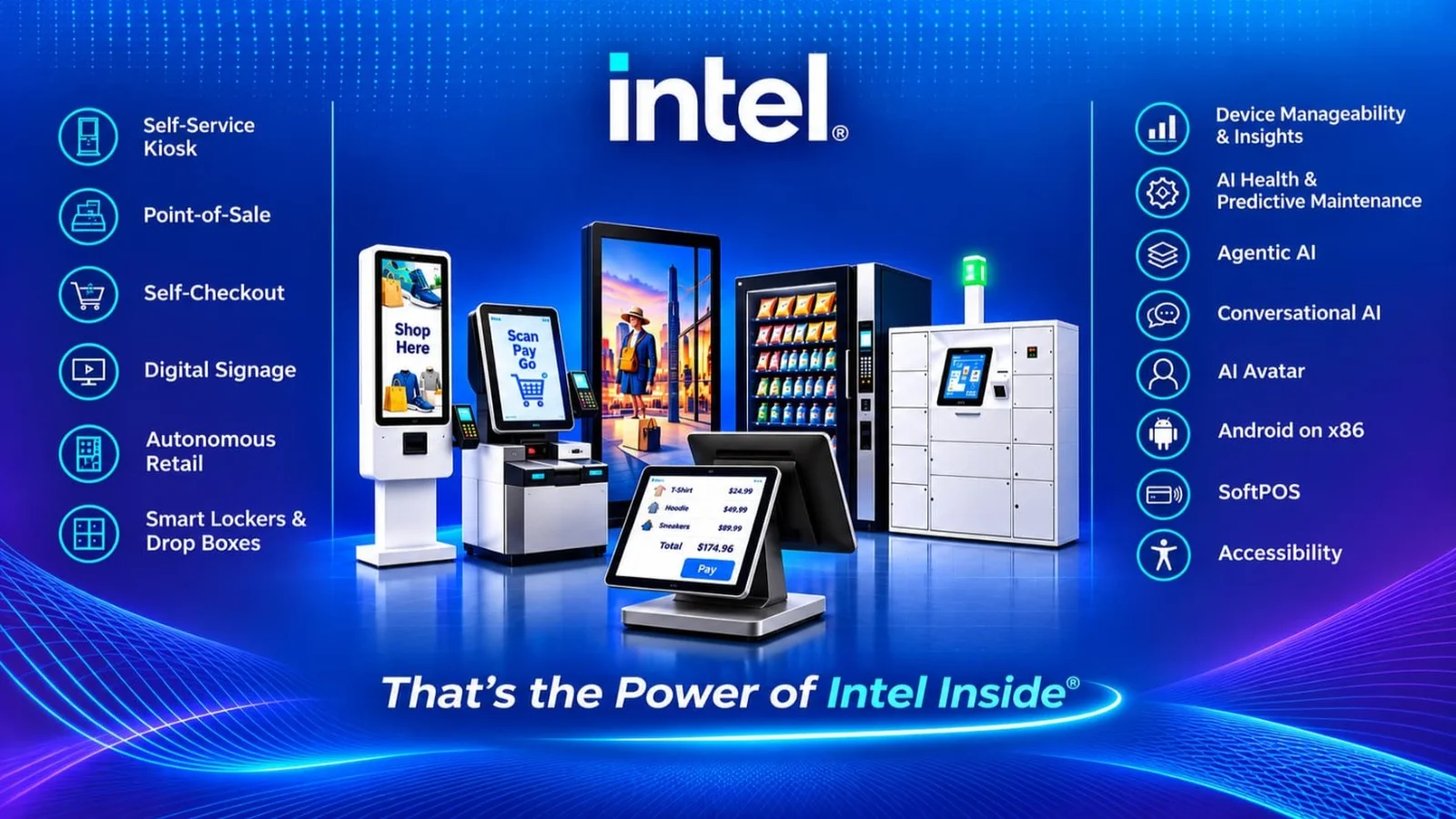
Intel Core Ultra is helping transform retail POS systems, kiosks, self-checkout terminals and digital signage into AI-enabled platforms. With integrated processing for computer vision, conversational AI and analytics, the technology offers new opportunities for personalization, accessibility and operational efficiency.
November 8, 2026 | Kathy Crumley, Global Solutions Manager, Intel Corp.
 ChatGPT
 Grok
 Perplexity
 Claude
Retail technology is entering a new phase. Devices that were once designed to perform a single, predictable function are becoming intelligent, adaptable platforms capable of supporting multiple workloads at the edge.
A point-of-sale system can now help detect suspicious transactions. A self-checkout terminal can use computer vision to improve item recognition. A kiosk can offer conversational assistance and accessible, multimodal interaction. A digital signage player can analyze engagement and adapt content in real time.
At the center of this transformation is Intel® Core™ Ultra compute, which brings CPU, GPU, and neural processing unit, or NPU, resources together in a heterogeneous architecture designed to run AI, graphics, vision, and traditional business applications on the same platform. Intel's edge portfolio supports workload placement across these compute engines, while the Intel® Distribution of OpenVINO™ toolkit helps optimize inference across Intel CPUs, GPUs, and NPUs.
For the retail channel, the value extends well beyond processor performance. Intel Core Ultra provides a foundation for creating differentiated devices, expanding software and service opportunities, simplifying fleets, and modernizing deployed infrastructure without abandoning the broad x86 ecosystem that retailers already know.
Retail devices are evolving into multipurpose platforms
Retailers have traditionally deployed separate devices for transaction processing, customer engagement, digital media, loss prevention, and operational analytics. That model increases the number of systems that channel partners must integrate, secure, manage, and support.
Intel Core Ultra creates an opportunity to consolidate more of these functions onto intelligently designed edge systems. Depending on the selected processor and system configuration, partners can use heterogeneous compute resources to assign general-purpose applications to the CPU, parallel AI and graphics workloads to the GPU, and sustained AI inference to the NPU.
This architecture is especially important at the edge, where devices must balance performance, power, thermals, responsiveness, and cost. Intel Core Ultra edge platforms span a range of power envelopes and offer integrated AI and graphics capabilities that can help system builders support demanding workloads without automatically adding a discrete accelerator.
The result is not simply a faster retail endpoint. It is a more flexible device platform that can evolve as software requirements and AI use cases expand.
Point of sale: From transaction processing to intelligent store operations
The POS remains one of the most business-critical devices in the retail environment. It must process transactions reliably, support peripheral devices, protect payment and customer data, and remain available throughout store operating hours.
Intel Core Ultra allows the POS to retain those core responsibilities while taking on new edge workloads. An AI-capable POS platform could support:
- Transaction and behavioral analytics
- Suspicious activity or exception detection
- Personalized promotions and recommendations
- Employee assistance applications
- Speech-enabled workflows
- Local inventory and product-information queries
- Computer vision from nearby cameras
- Generative AI assistance for store associates
Conversational AI is particularly promising. Associates could ask questions about product availability, compatibility, promotions, or store policies using natural language rather than moving between multiple applications. An Intel-supported in-store assistant solution from Nybsys demonstrates how conversational and recommendation workloads can run on Intel Core Ultra-based edge systems, providing low-latency responses while reducing dependence on constant cloud processing.
Local execution can also help organizations maintain greater control over operational data. Not every prompt, image, or transaction-related event must be sent to the cloud for processing. Retailers can determine which workloads should remain in the store and which require centralized services.
For the channel, this creates opportunities to sell POS as part of a broader intelligent-store solution, combining hardware, AI applications, integration, deployment, lifecycle services, and remote support.
Kiosks: More natural, accessible, and personalized interactions
Kiosks are often expected to serve the widest possible range of users. Customers may speak different languages, have different levels of technical experience, or require visual, auditory, cognitive, or physical accommodations.
AI-enabled kiosks can provide a more adaptive interface through capabilities such as:
- Natural-language product and service discovery
- Voice-based navigation
- Multilingual interaction
- Speech-to-text and text-to-speech
- Visual guidance and dynamic interface adjustment
- Camera-assisted presence or gesture detection
- Personalized recommendations
- Virtual agents and digital assistants
These features can improve accessibility by giving customers more than one way to complete a task. Instead of relying exclusively on a fixed touchscreen workflow, a kiosk can combine touch, voice, audio, vision, and conversational interaction.
Accessibility must still be designed deliberately. AI does not replace accessible interface standards, appropriate physical design, readable content, privacy safeguards, or human assistance. However, local AI processing gives kiosk manufacturers and solution providers more tools for creating experiences that respond to individual user needs.
Intel Core Ultra is well suited to this category because the kiosk may need to run the primary application, user interface, graphics, AI inference, peripheral control, security services, accessibility functions, and remote-management software simultaneously. The availability of integrated CPU, GPU, and NPU resources gives developers greater flexibility in distributing those workloads.
Self-checkout: Applying computer vision where it matters most
Self-checkout illustrates why edge AI is becoming operationally important. Traditional systems depend heavily on barcode scanning and user input. When items are entered incorrectly, left unscanned, or confused with similar products, both the shopper experience and store profitability can suffer.
Computer vision can add another layer of intelligence by supporting:
- Product detection and classification
- Produce recognition
- Barcode and image correlation
- Missed-scan detection
- Item movement tracking
- Suspicious behavior alerts
- Age-verification workflow assistance
- Queue and lane monitoring
Running these workloads close to the checkout lane helps reduce the latency associated with sending video or image data to a remote cloud service. It can also support privacy-conscious architectures in which raw video remains local and only events, metadata, or alerts are transmitted.
Intel's Open Edge Platform retail software direction specifically identifies vision-powered object detection, classification, anomaly detection, order accuracy, loss prevention, and agentic AI as target retail workloads.
OpenVINO further helps developers optimize and deploy inference workloads across Intel hardware and supports commonly used AI model frameworks and formats, including TensorFlow, PyTorch, and ONNX. This gives independent software vendors and system integrators a path for bringing existing models into Intel-based retail solutions while selecting the most appropriate compute engine for a given workload.
For retailers, the objective is not surveillance for its own sake. It is better transaction accuracy, faster exception handling, reduced friction, and a more effective allocation of store associates.
Digital signage: Turning displays into intelligent engagement platforms
Digital signage is also evolving beyond scheduled content playback.
With Intel Core Ultra compute, one signage endpoint can potentially support high-resolution media, content-management software, audience analytics, computer vision, and real-time content decisions. Depending on configuration, Intel Core Ultra edge processors can support advanced media and display features, including hardware-accelerated video processing and multi-display applications.
Computer vision can help signage systems understand broad engagement patterns, including:
- Whether viewers noticed a display
- Approximate dwell time
- Which content generated stronger engagement
- Product interaction near the display
- Traffic patterns by time or location
- Campaign effectiveness across store zones
Fleet manageability becomes a business requirement
AI-capable retail devices become more valuable, but they can also become more complex. A retailer may operate thousands of endpoints across stores, restaurants, airports, hospitals, entertainment venues, or transportation environments. Those systems may use different operating systems, application images, peripherals, and AI models.
Channel partners therefore need to consider the entire lifecycle:
- Provisioning and configuration
- Application and AI-model deployment
- Device health and performance monitoring
- Software and firmware updates
- Remote diagnostics and remediation
- Security-policy enforcement
- Asset inventory and compliance
- End-of-life migration
Intel platform technologies, together with OEM and independent software vendor management solutions, can support a more standardized x86 fleet strategy. The specific remote-management capabilities available will depend on the processor, chipset, firmware, operating system, device design, and whether the platform includes technologies such as Intel vPro®.
This distinction matters. Intel Core Ultra describes the compute foundation, while Intel vPro identifies a validated business platform with additional manageability, security, stability, and performance requirements.
The strongest channel offering combines capable hardware with a defined management architecture and service-level model. That can include remote monitoring, patching, incident response, device replacement, application management, and AI-model lifecycle services.
Security must extend from the device to the AI workload
Retail endpoints operate in public or semi-public environments and frequently connect to scanners, cameras, payment devices, printers, displays, sensors, and cloud services. This creates a broad attack surface.
A modern retail platform should therefore incorporate layered security across:
- Hardware and firmware
- Boot and operating-system integrity
- Application execution
- Device identity and authentication
- Data at rest and in transit
- Peripheral access
- AI models and associated data
- Remote-management credentials
- Physical device protections
Security outcomes depend on the complete configuration, including enabled hardware capabilities, firmware maintenance, operating-system controls, application design, network segmentation, identity management, and ongoing patching.
Local AI can provide an additional architectural benefit by allowing sensitive images, voice interactions, or operational data to be processed at the edge. However, edge processing does not eliminate privacy obligations. Retailers and channel partners still need clear data-minimization, retention, consent, access-control, and governance policies.
Android on x86 expands deployment choice
Android has become an important retail operating environment, particularly for touch-first POS systems, kiosks, self-checkout stations, and digital signage. At the same time, many retail deployments rely on x86-compatible applications, peripherals, management tools, and long-established integration practices.
Android on x86 can bring these two worlds together.
For device manufacturers and solution providers, this creates an opportunity to deliver an Android-style application experience on scalable x86 hardware. Potential channel benefits include:
- A familiar touch-centric operating environment
- Reuse of Android applications and developer skills
- Access to Intel-based performance and peripheral ecosystems
- Greater hardware choice across device categories
- A path to consolidate Android and traditional x86 fleets
- Support for AI, vision, media, and business applications on a common architecture
The implementation model requires careful qualification. Partners should validate the chosen Android distribution, processor generation, graphics stack, peripherals, security-update process, device-management framework, application compatibility, and hardware-acceleration support. Android compatibility should be defined at the complete system-image level, not assumed from the processor architecture alone.
When that work is completed, Android on x86 can give retailers an additional deployment option without requiring an entirely separate hardware strategy for every device category.
The channel opportunity: Build platforms, not just products
Intel Core Ultra gives the retail channel an opportunity to reposition device categories around business outcomes.
Device category | Traditional role | Intel Core Ultra-enabled opportunity |
POS | Transaction processing | Intelligent transaction analysis, associate assistance, personalization, and localized AI |
Kiosk | Structured self-service | Conversational, multilingual, multimodal, and more accessible customer interaction |
Self-checkout | Customer-operated scanning and payment | Vision-enabled recognition, transaction accuracy, exception detection, and loss-prevention assistance |
Digital signage | Scheduled media playback | Audience-aware content, engagement analytics, retail-media measurement, and real-time personalization |
The competitive advantage will not come from adding "AI" to a specification sheet. It will come from assembling a repeatable solution that includes the right device, operating environment, AI framework, applications, peripherals, management services, security controls, and ecosystem support.
OEMs can create differentiated device families. ODMs can accelerate specialized designs. ISVs can deliver AI and computer vision capabilities. System integrators can connect those applications to retail workflows. Distributors, resellers, and managed-service providers can package deployment, monitoring, security, and lifecycle support.
Together, these capabilities can turn a device sale into a long-term platform and services relationship.
A common foundation for the next generation of retail
The future retail environment will not be defined by one application or one form factor. It will be shaped by connected device fleets that can transact, observe, assist, communicate, and adapt.
Intel Core Ultra provides the heterogeneous compute foundation needed to advance that vision across POS, kiosks, self-checkout systems, and digital signage. Its combination of CPU, GPU, and NPU resources allows partners to support established retail applications while adding computer vision, conversational AI, accessibility functions, advanced graphics, and new edge intelligence.
Combined with OpenVINO, the broader Intel edge software ecosystem, properly configured management technologies, and qualified operating systems, Intel Core Ultra can help the retail channel build fortified systems that are more intelligent, manageable, secure, and adaptable.
The opportunity is larger than refreshing the device fleet. It is about transforming each retail endpoint into a strategic edge platform that can support the experiences and operational models retailers will need next.
Intel is honored to support our "Partner-Led, Channel-Focused" GTM motions with a robust and growing Industry Solution Builders (ISB) Community. For more insights, please visit: Intel® Industry Solution Builders | Intel AI Solutions & Technology for Industry Transformation.
Kiosks. Smart vending. Micro-markets. AI-powered automation. The Automated Retail & Kiosk Innovation Show brings the entire self-service ecosystem together Dec. 14-16 in Miami Beach to help businesses find new ways to serve customers and grow revenue.
Related Media
Subscribe
Get the latest news and resources from Kiosk Marketplace.