Automated Retail & Kiosk Innovation Show
CTS founder Sandra Nix on AI, kiosk evolution and what makes self-service deployments succeed
Kiosk Marketplace recently spoke with Nix in an email interview about how self-service has changed and more.

August 24, 2026 by Richard Slawsky — Editor, Connect Media
 ChatGPT
 Grok
Grok Perplexity
 Claude
When Sandra Nix founded Connected Technology Solutions in 2002, the self-service kiosk industry looked considerably different. Many companies treated kiosks as an extension of other manufacturing businesses, and the technology itself could amount to little more than a computer installed inside an enclosure.
Nix believed kiosks could do much more. More than two decades later, CTS has evolved into a vertically integrated self-service technology company with an 85,000-square-foot facility and in-house capabilities spanning design, engineering and fabrication to deployment, field service and long-term support. Nix says the industry has evolved as well, with increasingly sophisticated customers and a growing convergence between kiosks, vending and unattended retail.
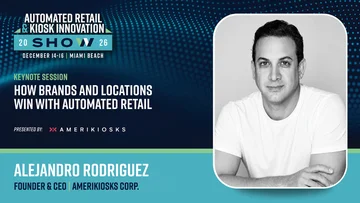
Nix also serves on the steering committee for the Automated Retail & Kiosk Innovation show, bringing the perspective of a longtime kiosk manufacturer and deployer to an event focused on the convergence of kiosks, vending and other forms of automated retail. The show is being held Dec. 14-16 in Miami Beach, Florida.
Kiosk Marketplace recently spoke with Nix in an email interview about how self-service has changed, why total cost of ownership is becoming more important than initial purchase price, the role of artificial intelligence and what operators should consider before investing in their next self-service deployment.
Q: Connected Technology Solutions has grown alongside the rapid evolution of self-service technology. Looking back, what changes have had the greatest impact on the business?
Nix: When I started CTS back in 2002, the industry itself was very new and unfocused. Most kiosk providers were actually companies doing other things and wanted a side hustle for the offseason. They made trade show booths, retail displays, even hot tubs. The consensus was you could throw a PC in a box and call it a day.
From the start, I thought we could do more and that kiosks could provide significant advantages to our customers by leveraging technology for efficiencies and improved experiences for their customers.
Over time, customers have become more sophisticated. Their demands on us have driven a focus on constantly improving and leveraging new technologies. Most of the companies in this space 25 years ago are gone.
Kiosks and vending used to be different kinds of businesses — cousins in the same family. Over the years, overlapping technologies and a convergence of customer needs have made the two industries more like siblings. It won't be long before we're fully integrated and really just a single vertical.
Q: What separates successful technology deployments from those that fail to deliver the expected return on investment?
Nix: There are a lot of factors, but the most important by far is proper planning and project management. Deploying interactive technology isn't like dropping a PC on a desktop.
Kiosk deployment pulls from a lot of different specialties, from design to engineering, fabrication, integration of both equipment and software, logistics, internal and external marketing, deployment readiness consulting as well as long-term support and refresh to ensure long-term relevance.
From a customer's standpoint, first understand and define the purpose of the project. Articulating how to define success will keep the focus on the real purpose and define what the hardware and software need to accomplish.
Next, allocate or acquire sufficient resources. Choose software and hardware partners wisely, with an emphasis on providers who fill in the customer's resource gaps.
Finally, really take time to select your vendor partners. Check references. When they make claims, ask for evidence. Make sure you're comparing apples to apples because providers often use the same terms, but the deliverables can be very different.
Q: What responsibilities do technology vendors have in making those deployments successful?
Nix: Understand the mission. We have two ears and one mouth for a reason. Ask your customer what problem they are trying to solve and their goals for the project. Then listen.
Provide a solution that really solves the problem. It may be tempting to put them into one of our stock products and call it a day, but the best relationships and most successful projects are built over time by providing custom or customized solutions.
And remember, we serve at the pleasure of our clients. It isn't "going the extra mile"; it's doing the job. Whatever it takes for them to be successful. Measure your success in direct proportion to your customer's success.
Q: What are the biggest challenges kiosk operators and deployers face today compared with five years ago?
Nix: Five years ago, it was all about ROI, to an extreme. Deployers would buy the cheapest software and hardware they could find and drop it into a space, expecting to walk away and things would just work.
As deployers struggled with the aftermath of that philosophy, our customers became more sophisticated and understood that while ROI is important, total cost of ownership is a better measure. It's part of an overall goal that also includes loyalty, brand experience and customer satisfaction.
As technology gets more sophisticated, our customers depend on us more and more to bench-test equipment and solutions and provide reliable, forward-looking products.
Our customers are also facing huge staffing shortages since COVID and need alternatives to continue servicing their customers. Today's customers are looking to deploy more sophisticated technology that provides a more effective, enjoyable and nuanced experience.
Q: How has your leadership style evolved as CTS has grown?
Nix: Starting out, I outsourced a lot. In relatively short order, I learned few vendors and even fewer consultants understood what I was trying to bring to the market in terms of superior-quality goods and service, so I began bringing more and more in-house.
Today, we're ridiculously vertically integrated and have an 85,000-square-foot facility because experience has taught me the only way to ensure excellence is to do it ourselves. Every aspect of every project is done in-house, from thought-bubble concept to decades of deployment support.
We integrate our own privacy panels because no manufacturer could pass our quality requirements. When trucking companies were damaging our kiosks in transit, we bought our own trucks so our kiosks never leave our control in transit. Our drivers are direct employees who are also trained technicians and perform installations.
We provide white-glove delivery services everywhere — Hawaii, Saipan, the Caribbean. Right now, one of our delivery specialists is on a boat with six kiosks to be delivered to a remote Alaskan island.
Q: Does that same philosophy extend to service and support?
Nix: We found customers were struggling with the setup of hardware and software, so we offer consulting support. When you call our help desk, you're talking to one of our team members in Wisconsin. Field service? Direct CTS employee.
Every person who touches any part of our customer's project is a direct employee of CTS, never a contractor. We hire them, train them and support their growth within the company because it's the only way we can control what our customers receive.
We say we build the best damn kiosks. The only way you can say that with confidence is if you control every bit of the process. That's what I've learned.
Q: What have you learned about building a strong team and company culture?
Nix: Culture is everything. If I take care of our employees, they take care of our customers. We hire people who are really smart, talented and love what they do.
Our IT team goes home at night and builds their own gaming computers. Our production specialists have amazing home shops where they spend their weekends building and woodworking. Our receptionist loves to talk on the phone and be host of the party. We screen for that — wicked-smart Type A's with a heart.
And kindness. We screen for kindness because we expect every team member to be kind.
We also have a dog-friendly workplace. On any given day, we can have from two to eight or more dogs in the office. They help everyone relax, take a beat and get perspective. Having a building full of competitive achievers is a handful, but that's my job - to herd the cats.
Our retention is great because besides good pay and benefits, and maybe more importantly, we support and respect each other, which leads to supporting and respecting our customers.
Q: What do you enjoy doing outside the self-service industry?
Nix: I love to cook and spend evenings with friends, so my husband and I entertain a lot. After decades of business travel, I've become a bit of a nester. We just bought a new home, so I'm unpacking and getting settled in right now.
Q: AI, cloud platforms, connectivity, digital payments and remote management are changing self-service. Which technologies do you think will have the greatest impact over the next five years?
Nix: I look at technology in general as an ecosystem. Our health care customers, for example, may register patients via phone, home computers, on-site kiosks or any number of systems. A patient-centric system will incorporate all those technologies to provide the best experience based on what the patient wants.
Another client of ours is in the border control and identity management space. Their kiosks can identify and process up to 200 faces per minute in a crowd. The AI behind everything from design to implementation is amazing and will continue to take us forward at lightning speed.
The technology and designs we're delivering in the bike-share space, especially looking forward with e-bikes, are very cool.
Q: Are there technologies you think have received more attention than they deserve?
Nix: We've seen some technology make big promises that never really delivered. Palm vein scanners, for example, were never particularly effective, especially in the kiosk space.
Too many software products came to market without being thoroughly tested and were — and are — problematic. If it's not bulletproof, it shouldn't leave the garage.
Q: If you could offer one piece of advice to a vending operator, kiosk deployer or unattended retail business investing in technology today, what would it be?
Nix: Do your homework. Be clear on what you want and very specific about your expectations and what you need to get there.
Don't hesitate to reach out to providers who are experienced and who you trust - but make them earn that trust.
Upcoming Events
Automated Retail & Kiosk Innovation Show
December 14-16, 2026 | Miami Beach, FL
Explore the latest breakthroughs in automated retail, interactive kiosks, and unattended technology — and unlock new ways to serve customers and grow revenue.
View AgendaRegister NowAbout Richard Slawsky
In addition to writing, Slawsky serves as an adjunct professor of Communication at the University of Louisville and other local colleges. He holds both a Bachelor’s and a Master’s degree in Communication from the University of Louisville and is a member of Mensa and the National Communication Association.
Included In This Story

Connected Technology Solutions
We Build the Best Damn Kiosks. Period.®
CTS has been developing and deploying custom designed and semi-custom kiosks since 2002. Our kiosks are engineered to be rugged and appropriate for the environments in which they are used.
Related Media
Subscribe
Get the latest news and resources from Kiosk Marketplace.
Recent Posts