Transportation
Can AI holograms change airport wayfinding?
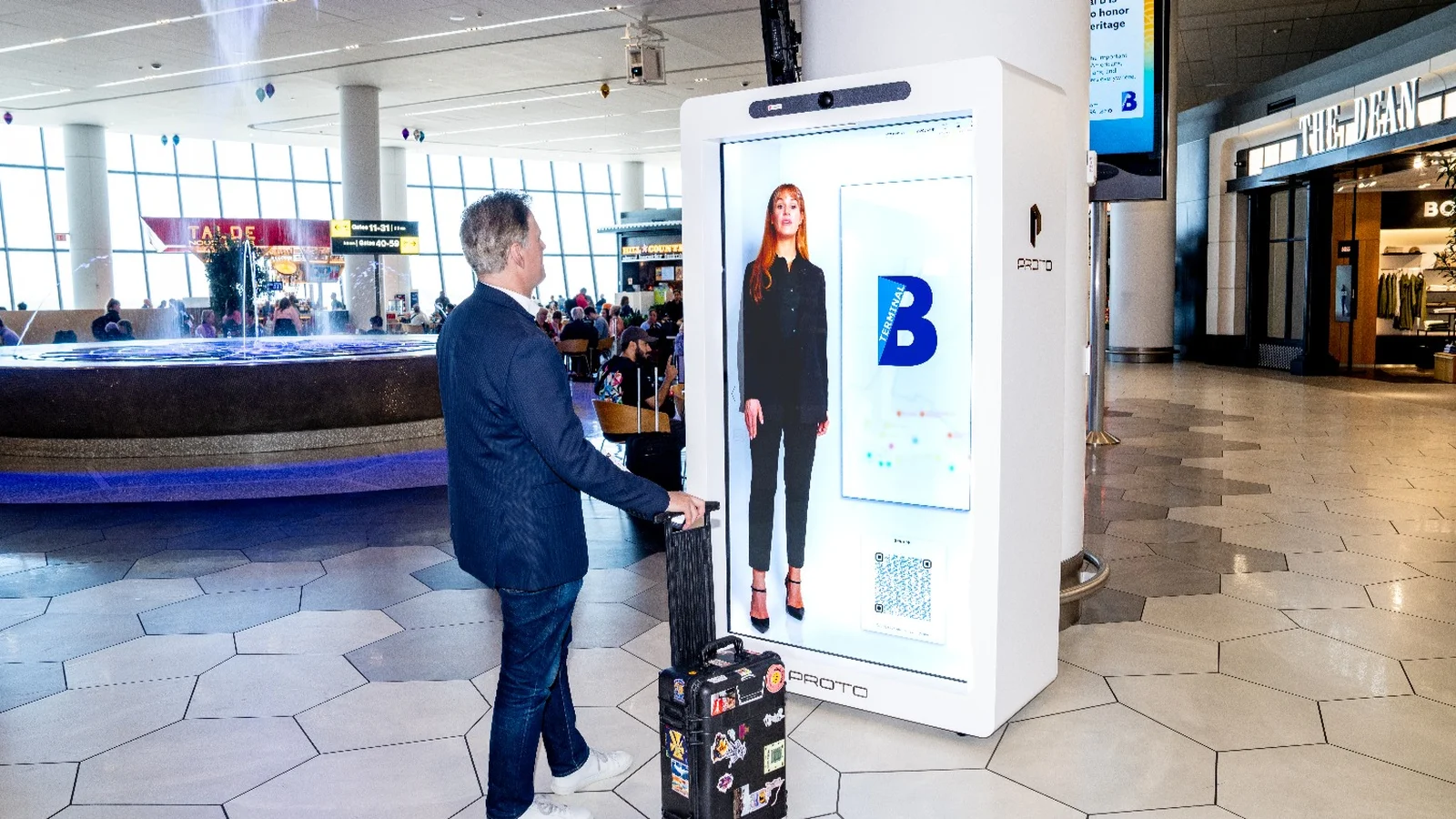
New York's LaGuardia Airport is testing what may be the next evolution of passenger assistance: interactive AI-powered hologram ambassadors. LaGuardia recently deployed at Terminal B what it describes as the airport industry's first fully interactive AI hologram designed specifically for guest services and wayfinding.
June 16, 2026 by Richard Slawsky — Editor, Connect Media
 ChatGPT
 Grok
Grok Perplexity
 Claude
For decades, airports have served as proving grounds for self-service technology. From check-in kiosks and self-bag drop systems to biometric boarding gates and digital wayfinding, airports often provide travelers with their first exposure to emerging technologies.
Now, New York's LaGuardia Airport is testing what may be the next evolution of passenger assistance: interactive AI-powered hologram ambassadors.
LaGuardia recently deployed at Terminal B what it describes as the airport industry's first fully interactive AI hologram designed specifically for guest services and wayfinding. The life-size digital ambassador, named Bridget, combines Proto Hologram's display technology with Holomedia's AI Concierge Wayfinder platform to help travelers navigate the terminal through natural-language conversations.
While holograms have appeared in airports before as marketing displays or prerecorded greeters, the LaGuardia deployment represents a different approach. Bridget is designed to answer questions, provide directions and assist passengers in real time, serving as an extension of the airport's human guest services team.
The installation raises an interesting question for the self-service industry: Can holographic AI avatars succeed where traditional kiosks, digital signs and mobile apps often struggle?
Beyond static wayfinding
Traditional airport wayfinding tools have relied heavily on maps, signs and touchscreen directories. Although effective, they typically require travelers to adapt to the technology rather than the other way around.
The hologram approach attempts to reverse that dynamic.
Travelers can ask Bridget for directions to gates, lounges, baggage claim areas, concessions and other terminal destinations using conversational language. The system provides step-by-step navigation assistance while supporting multiple languages, including English and Spanish, with additional languages planned.
According to LaGuardia Gateway Partners, the system is intended to complement—not replace—the airport's existing team of guest experience ambassadors. During peak travel periods, the hologram can continue assisting passengers while staff members are occupied elsewhere.
The deployment also incorporates accessibility features including high-contrast displays, closed captioning and a physical interface designed for wheelchair users.
Why airports make sense
David Nussbaum, founder and inventor of Proto Hologram, believes airports offer unique advantages as testing environments for emerging customer-facing technologies.
"Airports are exciting and inspiring places and at the same time put us in crowds in a very vulnerable state," Nussbaum said in an email interview. "We're tired, we're a little anxious, we might not speak the language. It's the perfect use case for kiosks and airports are an ideal lab to try new things."
That observation highlights a challenge many self-service deployments face: earning user trust.
Unlike retail environments, where customers may have time to browse or experiment with technology, airport travelers are often under stress. They may be dealing with unfamiliar surroundings, tight schedules, language barriers or travel disruptions. Any self-service solution deployed in that environment must be intuitive and trustworthy from the first interaction.
Nussbaum argues that holographic avatars provide advantages over more conventional digital interfaces because they introduce a stronger sense of human presence.
"AI hologram avatars in kiosks have human presence — three dimensionality, natural conversational tones and hyperrealism instill trust and make the experience memorable and engaging," he said.
That concept could have implications far beyond airports. One of the biggest challenges facing many kiosk deployments is encouraging initial engagement. A life-size human-like avatar may attract attention and invite interaction in ways that traditional touchscreen interfaces do not.
The next evolution of self-service
The LaGuardia deployment also illustrates how AI is changing expectations for self-service technology.
Historically, kiosks have been transactional tools. Users select from predefined options, complete a task and move on. AI-powered systems introduce the possibility of more dynamic and personalized interactions.
According to Nussbaum, future hologram systems may adapt their responses based on passenger behavior and context.
Proto's platform incorporates microphones, cameras and other sensors capable of responding to real-time conditions. A future system might recognize whether a traveler appears rushed, confused or relaxed and tailor its assistance accordingly.
The company also envisions systems that remember previous interactions and anticipate follow-up questions when travelers return later.
These capabilities point toward a broader shift occurring throughout the self-service industry. Rather than simply automating transactions, emerging AI-powered platforms are beginning to emulate aspects of human service interactions.
For airports, that could translate into reduced pressure on guest services staff while maintaining a high-touch customer experience.
Competing with smartphones
One challenge facing any new self-service technology is the omnipresence of smartphones.
Many airports already provide mobile apps with maps, flight information and navigation assistance. Some observers question whether dedicated wayfinding kiosks remain necessary when travelers already carry connected devices.
Nussbaum believes physical installations still offer advantages.
"A self-contained unit makes the experience feel complete and natural," he said. "Some solutions that require a third screen tablet or rely on the passenger's own phone don't bring much value."
The argument reflects a growing trend within the kiosk industry. Increasingly, successful deployments are not attempting to replace smartphones but rather complement them by providing immediate, visible and accessible assistance within physical environments.
The hologram's ability to attract attention, initiate engagement and deliver assistance without requiring downloads, registrations or app navigation could prove particularly valuable for infrequent travelers.
A glimpse of what's ahead
While Bridget has generated significant media attention since its May debut, publicly available traveler feedback remains limited. Early social media reactions have largely focused on the system's novelty and futuristic appearance, though formal passenger satisfaction data has not yet been released. The success of the deployment may ultimately depend less on the novelty of the hologram and more on measurable outcomes such as passenger engagement, wayfinding efficiency and user satisfaction.
Nussbaum points out that holographic avatars offer advantages beyond simply delivering information.
"The thing with a hologram avatar helping you while you're traveling through an airport is that it's calming, it's reassuring," he said. "You are the focus of attention for that avatar while you're engaging with it, and she earns your attention by having presence, conversing naturally in your language, and by giving helpful information."
He added that while passengers can still access information through QR codes and mobile devices, the hologram experience may improve comprehension and retention while creating a more welcoming atmosphere.
LaGuardia Gateway Partners views the deployment as part of a broader effort to use airports as testing grounds for emerging customer experience technologies. A spokesperson said modern travelers increasingly expect seamless, stress-free journeys and that airports provide an ideal environment to evaluate new solutions because of their diverse passenger base and well-understood travel behaviors.
If AI hologram ambassadors can demonstrate measurable improvements in passenger satisfaction, operational performance and wayfinding efficiency, similar deployments could emerge across shopping centers, hospitals, convention centers, universities and other public venues. Whether travelers ultimately embrace holographic assistants remains to be seen, but the deployment offers an early look at how AI may reshape the next generation of self-service.
About Richard Slawsky
In addition to writing, Slawsky serves as an adjunct professor of Communication at the University of Louisville and other local colleges. He holds both a Bachelor’s and a Master’s degree in Communication from the University of Louisville and is a member of Mensa and the National Communication Association.
Related Media
Featured Vendor

Grow faster using DPL’s AI Powered Hercules Platform featuring built-in RMS. Level the playing field with unparalleled remote management capability. Spend less time putting out fires and more time landing locations with DPL’s managed wireless service, referred to as the “gold standard” amongst operators.
Subscribe
Get the latest news and resources from Kiosk Marketplace.