Transportation
Boston Logan pilots AI hologram concierge
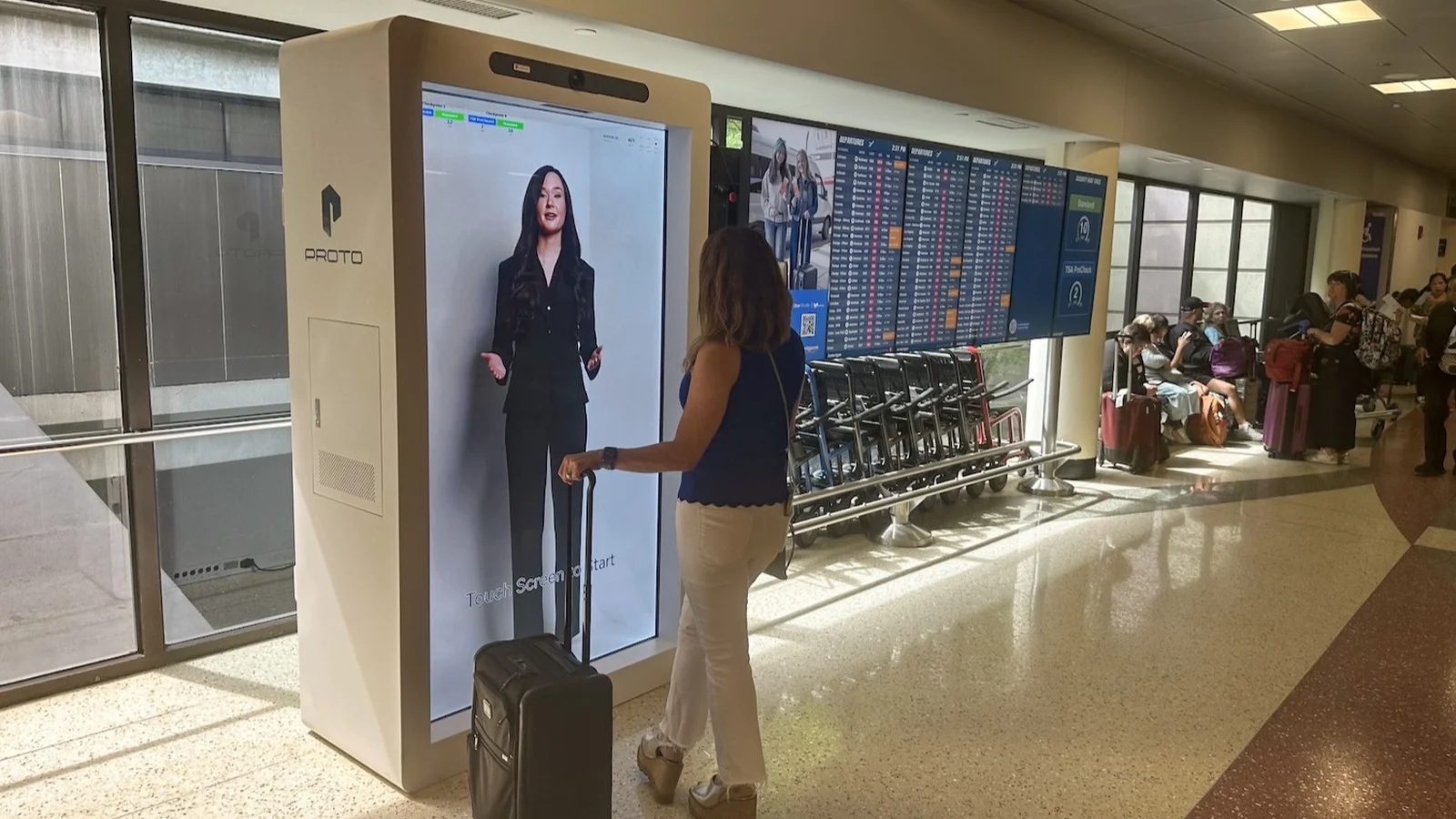
Boston Logan International Airport has introduced a life-size artificial intelligence hologram designed to help passengers navigate the airport, check security wait times and connect with customer service employees.
September 8, 2026 by Richard Slawsky — Editor, Connect Media
 ChatGPT
 Grok
Grok Perplexity
 Claude
Boston Logan International Airport has introduced a life-size artificial intelligence hologram designed to help passengers navigate the airport, check security wait times and connect with customer service employees. The Massachusetts Port Authority is testing the self-service concierge as part of a pilot program intended to supplement the airport's existing passenger assistance options.
Named Amelia, the AI avatar can respond to spoken questions and provide step-by-step directions to gates, restaurants, shops, lounges, baggage claim areas and other destinations. The self-contained Proto unit combines a holographic display with a touchscreen, live airport maps and real-time Transportation Security Administration checkpoint information.
Nine Amelia units have been placed throughout Boston Logan, including one in Terminal A, according to a Boston Globe report. Proto Hologram founder David Nussbaum told the newspaper that the system is projected to provide more than 150,000 passenger assists during its first 12 months.
The system initially contains information on about 400 airport points of interest, with plans to add approximately 600 more. Amelia can also display 3-D maps and generate QR codes that passengers can scan for directions on their phones.
Nussbaum also said one in five interactions has occurred outside typical staffed hours. Amelia is designed to remain available around the clock, extending passenger assistance beyond the hours when airport information desks are typically staffed.
Amelia can communicate in as many as 40 languages, although the initial Boston deployment includes English, Spanish and French. Travelers can speak to the avatar conversationally instead of navigating a series of touchscreen menus. If Amelia cannot resolve a request, the system can connect the passenger with a live customer service representative.
Accessibility features include high-contrast displays, closed captioning, wheelchair-accessible positioning and maps designed to comply with Web Content Accessibility Guidelines.
Boston largest airport deployment to date
Massport developed the concierge in partnership with Proto Hologram and Holomedia AI. The companies said Boston Logan is the largest airport to offer the service and that the installation marks Proto's first major deployment in the Boston area.
Proto's holographic systems are also used in health care, education, retail, finance, sports and entertainment.
"It takes bold vision to implement emerging technologies like holograms and AI avatars, innovations that still feel like science fiction to most people," Nussbaum said in the announcement. "But Massport understands that the technology is ready now, and that it can create a smoother and more pleasant experience at Boston Logan while also supporting the human staff so they can do their best too."
The deployment comes as Boston Logan handles more than 43 million passengers annually. The airport served 43.2 million passengers in 2025, according to Massport. More than 40 airlines offer nonstop service from Logan to over 100 domestic and international destinations.
The airport's passenger volume and mix of domestic and international travelers provide a demanding environment for testing conversational wayfinding technology. Travelers may be unfamiliar with the airport or unable to communicate easily with airport employees.
The Boston pilot follows a similar deployment at LaGuardia Airport's Terminal B. That airport introduced Bridget, an interactive AI hologram that uses Proto's display technology and Holomedia's AI Concierge Wayfinder platform. Bridget answers passenger questions, provides directions and supports airport guest service employees during busy periods.
Nussbaum previously told Kiosk Marketplace that airports provide a strong testing ground for holographic self-service because passengers may be tired, anxious, pressed for time or facing language barriers. He said the 3-D presentation and conversational capabilities can help attract users and create a greater sense of human presence than a conventional touchscreen.
The technology is not intended to replace airport employees. According to the announcement, Amelia is expected to assist passengers during peak travel periods, fill service gaps and allow staff members to devote more time to complicated customer service issues.
Massport has not disclosed how long the pilot will run, what criteria it will use to evaluate the technology or whether it has collected preliminary passenger-satisfaction data.
"Amelia combines the best of human connection with the power of AI," Glenn E. Smith of Holomedia AI said in the announcement. "We designed her to meet travelers where they are, in their language, at their pace, helping them navigate the airport with confidence and ease."
About Richard Slawsky
In addition to writing, Slawsky serves as an adjunct professor of Communication at the University of Louisville and other local colleges. He holds both a Bachelor’s and a Master’s degree in Communication from the University of Louisville and is a member of Mensa and the National Communication Association.
Related Media
Subscribe
Get the latest news and resources from Kiosk Marketplace.
Recent Posts