Hardware
The OnMed CareStation targets healthcare access gaps as telehealth accelerates
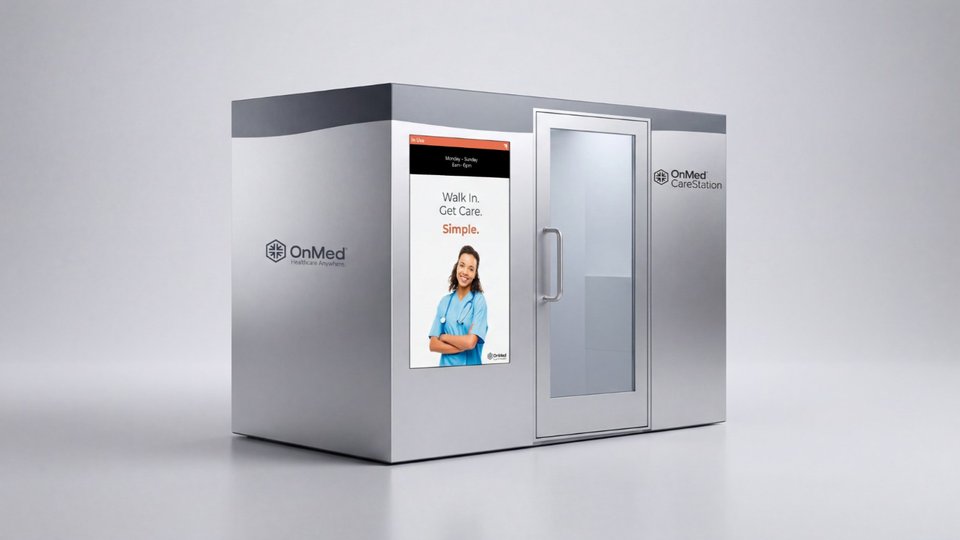
Physician shortages, rising costs and uneven access to care increasingly plague the U.S. healthcare system. Helping address those issues are telehealth kiosks, especially the OnMed CareStation.
March 3, 2026 by Richard Slawsky
 ChatGPT
 Grok
Grok Perplexity
 Claude
Physician shortages, rising costs and uneven access to care increasingly plague the U.S. healthcare system. Helping address those issues are telehealth kiosks, which combine remote consultation, diagnostics and medical advice in settings where such services have been difficult to deliver.
The opportunity is substantial. One studyvalued the global telehealth kiosk market at roughly $314.7 million in 2023, projecting it to grow at nearly 20% annually through 2030, driven by demand for accessible care and digital health adoption. More broadly, telehealth kiosk deployments are expanding alongside a rapidly growing digital health sector and the increasing consumerization of healthcare.
White Plains, New York-based OnMed is among the vendors seeking to scale this model. The OnMed CareStation platform delivers primary and urgent care services in compact, enclosed clinical environments located in community spaces. Kiosk Marketplace reached out to OnMed CEO Karthik Ganesh to discuss the company's deployment strategy, clinical capabilities and how the technology fits into the evolving healthcare infrastructure landscape.
Q: What is the OnMed CareStation?
Ganesh:The OnMed CareStation is an 8×10-foot "Clinic-in-a-Box" designed to expand healthcare access for the roughly 120 million Americans who lack adequate care. It combines one-on-one clinical consultation with the scalability of virtual care.
Each CareStation includes diagnostic tools, real-time scans, and vital sign monitoring to deliver comprehensive visits at scale. About 80% of patients who use the CareStation do not have a primary care provider, and for many, it becomes their medical home.
Our long-term vision is a national CareStation grid capable of serving up to 200 million lives annually by creating a scalable healthcare access infrastructure.
Q: Where are CareStations typically deployed?
Ganesh: CareStations are placed in trusted community locations that people already visit regularly. These include libraries, community and senior centers, employer sites, schools and government facilities.
The platform is currently deployed across Alabama, Connecticut, Florida, Georgia, Texas, Nevada, South Carolina and Puerto Rico, with expansion underway.
Q: Beyond rural areas, what locations are a strong fit?
Ganesh: Rural communities are critical, but access challenges extend well beyond geography. Approximately 80% of U.S. counties experience some form of healthcare access gap.
Healthcare deserts also include urban and suburban areas where long wait times, clinician shortages, high costs or cultural barriers limit access. CareStations address these infrastructure gaps by delivering services closer to where people live and work.
Q: How do CareStations affect healthcare costs?
Ganesh: They reduce costs for both patients and healthcare systems.
The U.S. faces a growing physician shortage and substantial spending on avoidable care. Emergency department treatment can cost more than ten times a physician office visit for similar conditions, creating major system inefficiencies.
CareStations help redirect patients to appropriate care settings. About 82% of patients are treated on site without escalation, and 58% report they would otherwise have gone to an emergency room or urgent care center. In rural deployments, CareStations generate significant economic retention by keeping healthcare spending within local communities.
Q: How are insurers and providers responding?
Ganesh: Payers, providers and public partners increasingly view CareStations as part of the solution to healthcare access challenges.
Traditional clinics require substantial capital investment, and the country faces a shortage of 200,000-plus physicians with only about 18,000 new doctors added each year.
Q: Can clinicians prescribe medications through the platform?
Ganesh: Yes. Licensed clinicians can prescribe medications when clinically appropriate.
The CareStation integrates diagnostics, vital sign monitoring and remote consultation into a hybrid care model that combines in-person clinical experience with telehealth scalability.
Q: What are the limitations of the care model?
Ganesh: CareStations are designed primarily for routine primary care, urgent care needs and chronic condition monitoring. About 44% of patients have chronic conditions, many of whom are receiving consistent care for the first time.
However, the platform does not replace specialty care. Patients requiring complex or long-term treatment are triaged to appropriate providers.
Q: What types of conditions can the CareStation treat?
Ganesh: The platform supports a wide range of routine and chronic health services, including:
- Respiratory infections and flu-like illnesses.
- Eye and ear infections.
- Allergies and asthma.
- Skin conditions and wound care.
- Digestive issues and mild abdominal pain.
- Urinary tract infections and screenings.
- Hypertension and chronic condition monitoring.
- Minor injuries and pain management.
- Medication refills.
- Mental health screenings.
- Diabetes and obesity management.
- Routine vitals checks and health education.
Q: What is the broader vision for the CareStation model?
Ganesh: This is not about replacing traditional clinics or telehealth — it's about filling the gap between them.
Many communities lack reliable broadband for video visits, while virtual care alone cannot provide diagnostics or vitals monitoring. Meanwhile, traditional facilities face scalability limits and workforce constraints.
CareStations represent a shift toward a distributed healthcare infrastructure. For employers, they improve productivity and reduce healthcare costs. For schools, they reduce absenteeism. For health systems, they help avoid unnecessary emergency visits and reduce clinician workload. For governments, they provide scalable access in underserved regions.
Ultimately, we're demonstrating that comprehensive care can be delivered anywhere it's needed.
Telehealth kiosks move into mainstream healthcare infrastructure
The growth of platforms such as OnMed's CareStation reflects broader market trends across healthcare self-service technologies.
At the same time, telehealth usage has become standard practice across the healthcare sector, with more than 70% of physicians reporting weekly use of telehealth tools.
For the self-service technology industry, telehealth kiosks represent a convergence of several trends: distributed service delivery, healthcare consumerization, AI-assisted diagnostics and community-based infrastructure. Vendors such as OnMed are positioning their platforms not only as telemedicine tools but also as scalable access infrastructure designed to complement traditional healthcare delivery models.
About Richard Slawsky
In addition to writing, Slawsky serves as an adjunct professor of Communication at the University of Louisville and other local colleges. He holds both a Bachelor’s and a Master’s degree in Communication from the University of Louisville and is a member of Mensa and the National Communication Association.
Related Media
Subscribe
Get the latest news and resources from Kiosk Marketplace.