Hardware
Food pickup lockers addressing the 'last mile' in the guest experience
Smart pickup lockers are helping address one of the key points (and cost issues) in restaurant operations. Additionally, their success is opening the door to expansion beyond traditional restaurant settings.
April 7, 2026 by Richard Slawsky — Editor, Connect Media
 ChatGPT
 Grok
Grok Perplexity
 Claude
Imagine yourself just having placed an order at the counter of your favorite fast-casual restaurant during a busy lunch. Or worse yet, working behind that counter.
A crowd builds up in the pickup area as people listen for their name or order number to be called. At the same time, drivers from third-party delivery services impatiently cut through the crowd, asking for their own orders. Some orders sit on the counter as their intended recipients don't answer the call.
Trying to sort out the confusion is a staff member whose time is split between taking orders and getting them to the right person. That's the scene playing out in restaurants across the country every day.
"At a traditional pickup counter, the handoff is sort of open-ended," said Ashley McNamara. vice president of global marketing with Mason, Ohio-based Apex Order Pickup Solutions, a provider of 'smart' food pickup lockers, in an email interview.
"Staff set an order down, someone eventually picks it up (or doesn't), and there's constant monitoring, calling out names, managing confusion about whose order is whose," McNamara said. "It pulls focus away from the next order."
Those smart pickup lockers, like the ones Apex provides, are helping address one of the key points (and cost issues) in restaurant operations. Additionally, their success is opening the door to expansion beyond traditional restaurant settings.
Stopping the restaurant 'porch pirate'
While some operators have moved to placing completed orders on shelves or cubbies for customers to pick up on their own, that method is about as secure as a package delivery service leaving the item you ordered on your front porch. It works in most cases, but it depends largely on the honesty of those who happen to be passing by.
Statistics are difficult to come by, but some operators report losing as many as 8 orders a day due to stolen pickup orders or those that go cold before they are matched to a customer. At an average order value of $12-$14 per order, that equals as much as $112 per day, or roughly $2,000–$3,000 per month in losses per store. Additionally, most orders must be remade, doubling the impact on labor and food cost.
For a chain with 10 restaurants, those losses can add up to a staggering $350,000 or more per year.
Smart food locker technology is rapidly moving from a niche solution to a mainstream operational tool across foodservice, offering a digital solution to the challenge of managing order pickup without creating congestion, confusion or labor strain.
A Market Intelo research report predicts that the global smart food locker pickup market will reach $6.4 billion by 2023, growing at a compound annual rate of more than 20% from $1.2 billion in 2024.
"The smart food locker pickup market is witnessing a sweeping transformation, primarily fueled by the digitalization of food ordering and fulfillment processes," the report authors wrote. "As consumers increasingly demand contactless, frictionless and hygienic food pickup options, foodservice operators are embracing smart locker solutions to modernize their operations and enhance customer satisfaction."
Initially gaining traction in college and university dining programs, smart lockers have quietly emerged as one of the fastest-growing workflow solutions in higher education. More than 60 campuses have deployed Apex's technology, drawn by its role in streamlining order fulfillment, eliminating crowded pickup counters and ensuring accuracy in high-volume environments.
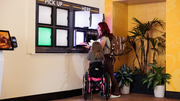
Apex lockers integrate with a restaurant's POS and online ordering systems to assign each order to a secure, temperature-controlled compartment. When the order is ready, staff place it in the locker and the customer receives an access code via text or app notification. The customer enters the code at the locker to retrieve the order.
"Average pickup time is around 10 seconds: guest gets a notification, walks up, scans, the compartment opens, they grab their order and go," McNamara said. "There's no risk of taking a wrong order. No one reaching past or handling another bag. No confusion at the counter. The right order waits for the right person to come pick it up."
The operational benefits extend well beyond speed. By shifting the pickup process away from staff interaction, foodservice teams can focus on preparation and quality rather than managing lines and verifying orders. Instead of acting as traffic controllers, employees remain behind the scenes, maintaining throughput and consistency during peak periods. Along with helping avoid waste and trim labor costs, those benefits can lead to increased sales.
"When the friction at handoff disappears, throughput tends to go up," McNamara said. "Which makes sense: kitchens can knock out significantly more orders in the same window of time because staff members aren't managing the chaos of the counter while trying to keep up with incoming tickets."
Moving beyond the restaurant
Along with offering an improved guest experience, smart pickup lockers provide operators with access to data on order volume, pickup times and traffic patterns, allowing them to better manage staffing, menu availability and kitchen workflows. By understanding when and where demand peaks occur, they can make more informed decisions about resource allocation and service design.
"Knowing how long orders sit in lockers before pickup tells operators a lot," McNamara said.
"It lets operators know whether notification timing is right, whether guests are engaging with the system the way they expected, and where there might be chokepoints in the pickup flow," she said. "The data turns the pickup operation from something operators manage reactively into something they can optimize proactively."
Those benefits are now appearing in a range of high-traffic environments, including entertainment venues, healthcare facilities, airports and casinos.
Each of these settings shares a common challenge: how to handle large volumes of customers on tight schedules, often in spaces where congestion can quickly degrade the overall experience.
In April 2025, Apex deployed its pickup locker solution at the Pittsburgh Zoo as part of a partnership with Cinchio Solutions, the digital solutions arm of guest experience provider SSA Ventures. Guests can place orders via Cinchio's mobile app or kiosks and pick up their food from a secure compartment. The system eliminates long lines and wait times, allowing guests to maximize their time at the zoo.
The success of that venture led SSA to roll out food pickup lockers at the Florida Aquarium in Tampa.
"At SSA Group, we're constantly looking for ways to improve the guest experience," said Carly Somma, VP of Business Transformation at SSA Group, in a press release announcing the deal. "The success at Pittsburgh Zoo & Aquarium showed us how powerful this technology can be, and we're excited to now bring it to The Florida Aquarium."
And at facilities such as Dayton Children's Hospital in Ohio, smart lockers offer a way to deliver meals to staff, patients' families and visitors with minimal disruption. Casinos and resorts, including the Yaamava' Resort and Casino in California, are leveraging locker technology to support round-the-clock operations. With guests moving between gaming floors, entertainment areas and hotel amenities, lockers provide a convenient way to access food without interrupting the overall experience. Airports are adopting smart lockers as well as they seek to address late-night demand, irregular flight schedules and limited staffing.
Looking ahead, the continued expansion of smart locker technology appears likely as foodservice operators seek solutions to ongoing labor challenges and rising consumer expectations.
"Again, mobile ordering, digital menus, contactless payment, etc., those are standard now," McNamara said. Operators who didn't adopt them are playing catch-up, she said.
"We know the pickup experience is the next piece of that same shift, and, again, it's behind where ordering already is," she said. "It's the direction the industry is moving, and venues that get ahead of it will have a meaningful advantage over those that don't."
About Richard Slawsky
In addition to writing, Slawsky serves as an adjunct professor of Communication at the University of Louisville and other local colleges. He holds both a Bachelor’s and a Master’s degree in Communication from the University of Louisville and is a member of Mensa and the National Communication Association.
Related Media
Subscribe
Get the latest news and resources from Kiosk Marketplace.