Hardware
Eyes on the future: Vision screening comes to self-service kiosks
The vision-screening sector has delivered steady growth over the past several years. One study shows these kiosks can reach $2.7 billion by 2032.
March 24, 2026 by Richard Slawsky
 ChatGPT
 Grok
Grok Perplexity
 Claude
Kiosks have long played a vital role in health and wellness testing, beginning in the late 1980s with self-service blood pressure screening stations that are now a fixture in nearly every pharmacy, grocery store and big-box retailer.Today, kiosk-based screening services include kiosks that offer hearing tests, devices that offer mental health screening and ones that scan your feet and suggest a specific type of orthotics.
While vision-testing kiosks have been part of self-service wellness screening for nearly as long as the more well-known devices, advances in digital eye charts, automated refractive measurements, touchscreen interfaces and cloud connectivity are helping to propel them into the mainstream.
Expansion picking up steam
The vision-screening sector has delivered steady growth over the past several years. According to one study, the market grew from about $500 million in 2020 to $700 billion by 2025, a 5.2% compound annual growth rate over the period.
There are indications that's about to change. Another study forecasts that the market for vision-screening devices could reach $2.7 billion by 2032, growing at a 9–10% annual rate as new diagnostic technologies are deployed.
While relying on the accuracy of these predictions may not be the wisest course of action, other indicators suggest strong growth potential. Retail giant Walmart, for example, began piloting Eyebot vision-screening kiosks in December 2025 at 12 Walmart Vision Centers and four Sam's Club Optical Centers in Pennsylvania.
At Walmart stores, screening costs $25. For Sam's Club members, the service is included with their membership at participating club locations.
"In areas where access might be limited, tools like this help our teams serve customers and members more efficiently," Jason Wong, regional health and wellness director for Walmart, covering Pennsylvania, said in a press release. "It enables clinicians to focus on the comprehensive care they're uniquely trained to provide."
Walmart cited studies showing that more than 25% of U.S. counties lack an optometrist or ophthalmologist, a statistic particularly impactful in rural counties. That designation applies to 48 of Pennsylvania's 67 counties.
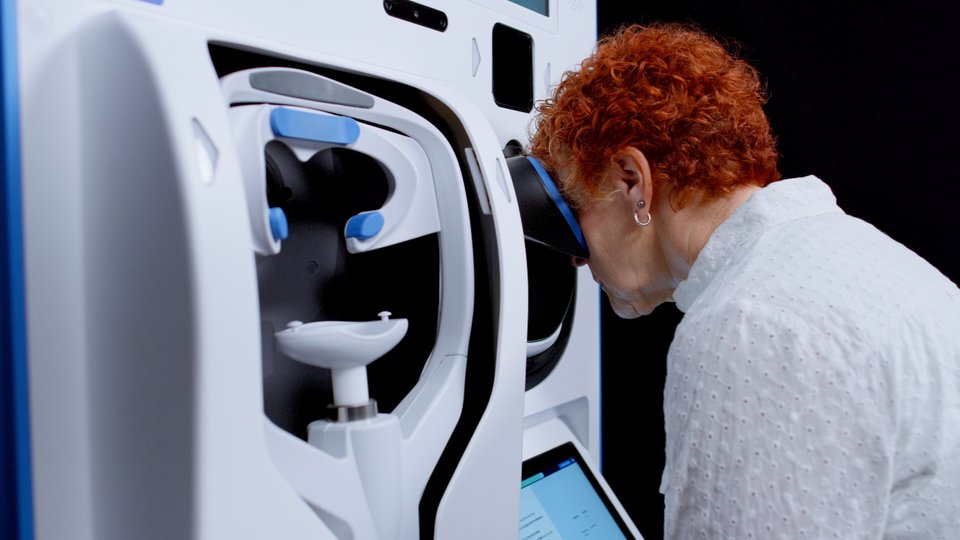
Eyebot's S1+ technology combines computer vision, automated refraction, and tele-optometry to produce an eyeglass prescription in minutes. The kiosk performs a short vision test lasting about 90 seconds, including:
- Visual acuity testing: Users read letters on a digital chart to determine how clearly they can see.
- Objective refraction: The machine uses optical sensors to measure refractive error (the need for glasses).
- Eye scanning: Imaging systems analyze how light reflects from the eyes to estimate prescription values.
- Lens scanning: If the user already wears glasses, the kiosk can scan the lenses to determine the current prescription.
The user stands in front of the kiosk and follows on-screen prompts to complete the test. It does not require placing the face against the device, unlike traditional optometry equipment.
"Eyebot was developed to expand access to vision correction by making prescription vision testing faster, more affordable, and easier to access in places people already go," Matthias Hofmann, Eyebot co-founder and CEO, said in an email interview.
"Millions of Americans need updated eyeglass prescriptions, but the traditional model relies on scheduling an appointment with a limited number of eye care providers," Hoffman said. "At the same time, demand for vision care continues to grow while the number of providers isn't keeping pace."
Along with potential retail partners, the company is seeing increasing interest from eye care professionals themselves, Hoffman said.
"Many optometrists, ophthalmologists and opticians recognize that technology like this can help handle routine prescription updates so they can focus their time on more complex care, medical eye conditions, and comprehensive exams," he said.
Not just for eyeglass prescriptions
Other providers of vision-screening kiosks are taking a different approach.
Miami-based company EyeCheq is developing eye-screening kiosks designed to detect vision problems and serious eye diseases.
EyeCheq's platform is intended to help identify conditions such as diabetic retinopathy, macular degeneration and other vision-threatening diseases before symptoms become severe. The kiosk typically delivers a self-guided exam lasting about five minutes, with reports delivered to patients and healthcare providers through a digital portal. The devices don't provide eyeglass prescriptions.
EyeCheq kiosks perform three primary screening functions:
- Non-mydriatic retinal imaging.
- Visual acuity testing (not prescribing).
- Autorefraction with keratometry.
"Checking visual acuity is critically important," Allen Hersh, chief development officer, EyeCheq, said in an email interview.
"Many people remain ambulatory or continue driving with vision worse than 20/40, which can increase the risk of falls, motor vehicle accidents, and other safety issues," Hersh said. "Simply identifying reduced visual acuity can prompt people to seek appropriate care."
Refractive error and corneal curvature measurements can help identify changes in visual status that may be an early indicator of conditions such as diabetes.
"Finally, we capture non-mydriatic retinal images, which allow screening for sight-threatening diseases such as diabetic retinopathy, macular degeneration, and glaucoma risk," Hersh said. "The retinal exam is really the clinical core of the platform, since many of these diseases develop silently and are only detectable through imaging."
The key distinction between EyeCheq and platforms that generate a lens prescription is that the EyeCheq kiosk is designed as a medical screening platform rather than a vision-testing device, he said. The goal is early detection and triage to help identify individuals who should be referred to an eye care professional.
Combining multiple approaches
Although not strictly self-service devices, the kiosks designed by Vero Beach, Florida-based GlobeChek provide eye screening in public locations while still involving licensed physicians in the diagnostic process.
The GlobeChek eye-screening kiosk, also known as the ESG-1200 Eye Screening Globe, is a globe-shaped station equipped with multiple diagnostic instruments. Tests include visual acuity testing, autorefraction, intraocular pressure measurement, corneal topography, optical coherence tomography (OCT), fundus photography and cataract grading. The kiosk performs a comprehensive "no-touch, no-dilation" eye scan in about eight minutes.
A technician typically guides the user through the screening process, after which the results are transmitted to a certified GlobeChek physician for interpretation. Within about 24 hours, the patient receives a digital report through an online portal along with recommendations for follow-up care if eye disease is detected. The system is designed to identify eye issues, including glaucoma, diabetic retinopathy, macular degeneration and cataracts.
A 2018 study involving a GlobeChek kiosk placed in front of an emergency room at a hospital in Manhattan screened 326 participants, detecting a sight-threatening eye condition in nearly half. Many of those participants had not had an eye exam in years.
The company hopes to place GlobeChek kiosks in areas such as hospitals, clinics, malls, airports and retail stores, as well as mobile units that can travel to communities with limited access to eye care.
Technology seeing some pushback
As with any technology that purports to transform an industry, there are those who aren't fans. Several state and national optometric organizations are voicing concerns about patient safety, regulatory compliance and the potential for consumer confusion.
The American Optometric Association, for example, argues that marketing and convenience could lead patients to rely on the technology rather than seeking full clinical evaluations. The AOA has also questioned whether partnerships between technology providers and eyewear retailers, such as the one between Eyebot and Walmart, comply with federal rules requiring separation between eye examinations and product sales.
Additionally, the Pennsylvania Optometric Association issued a safety alert in January decrying the deployment of Eyebot kiosks in that state.
"There is no substitute for an in-person eye exam, for full adherence by every doctor to the recognized standard of care or for the patient-doctor decision-making that every Pennsylvanian needs and deserves," said POA president Erin Draper in the alert. "Any corporation advising otherwise can and should be publicly fact-checked and, when necessary, investigated by the authorities."
Other eye-care specialists acknowledged, with caveats, the role kiosks can play in prompting people to seek care.
If someone has not had any interaction with eye care in years, a quick automated vision check may at least identify reduced visual acuity or a refractive issue and prompt them to seek care, said Dr. Yuna Rapoport, a board-certified ophthalmologist with Manhattan Eye in New York. Any screening is generally better than no screening at all, she said.
"However, it is important to understand what these systems are actually measuring," Rapoport said in an email interview. "Most kiosks primarily evaluate visual acuity and refractive error—essentially, whether you might need glasses or an updated prescription. Vision and glasses are only one component of a comprehensive eye evaluation."
Kiosk- screening can be a good option for adults who just need an updated glasses prescription and who have no eye diseases, Michael Chichak, a physician with the San Jose, California-based telehealth company MEDvidi, said in an email interview. The kiosks can eliminate barriers, he said, especially for those who might otherwise postpone care because of costs or the difficulty of attending an office visit.
"The danger is not the technology, but the misperception and false understanding of what it does," Chichal said. "The problem arises when a person believes that a 'normal' kiosk result means their eyes are in tip-top condition. Vision clarity is different from eye health."
Kiosk providers, though, stress that they make it clear to users exactly what the kiosks do and do not provide.
"Our kiosks are designed to offer a convenient option to get an eyeglass prescription and are not a substitute for comprehensive eye health examinations," Hoffman said.
"Every prescription is written and authorized by a licensed eye doctor in accordance with applicable state regulations," he said. "We encourage patients to maintain regular in-person comprehensive eye exams with their providers."
About Richard Slawsky
In addition to writing, Slawsky serves as an adjunct professor of Communication at the University of Louisville and other local colleges. He holds both a Bachelor’s and a Master’s degree in Communication from the University of Louisville and is a member of Mensa and the National Communication Association.
Related Media
Subscribe
Get the latest news and resources from Kiosk Marketplace.