Automated Retail & Kiosk Innovation Show
9 self-service tech trends to watch
The recent Automated Retail & Kiosk Innovation Show kicked off with a keynote on nine self-service trends to keep an eye on in the coming years: including computer vision, cobots and more.
January 27, 2026 by Bradley Cooper — Editor, ATM Marketplace & Food Truck Operator
 ChatGPT
 Grok
Grok Perplexity
 Claude
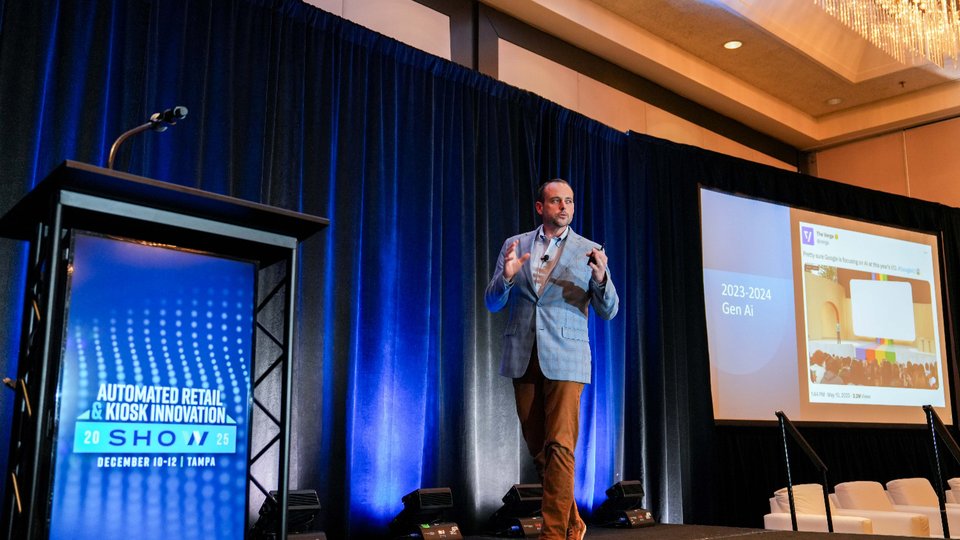
AI is top of mind for every industry, but in what way will it actually impact the self-service world? Will we see robots walking around anytime soon? The Automated Retail & Kiosk Innovation Show kicked off in Tampa, Florida, on Dec. 10-12, 2025 with a keynote address from Steven King, CEO of Blue Sky Robotics that tackled AI in depth and discussed 9 cutting edge trends to keep an eye on.
Robots aren't quite there first
While businesses are starting to deploy types of robotic assistants, King doesn't believe we are anywhere close to having a general rollout of fully autonomous robots. For one, there are many bugs that occur while just in demo mode, and trying to deal with a 100-pound robot that's going haywire in a business can be a big challenge.
"I don't think we're going to see this anytime in the next year or two where you're going to be interacting with them that's not highly supervised, much more in a demo situation, not in the total business value level," King said.
Computer vision
Instead, King believes we will see a more general rollout of computer vision, especially in kiosks. With computer vision, kiosks can detect its environment and the people around it and make decisions based on that information.
"It can know how long the line is and then make judgments on should it start promoting a particular extra add-on or should it just move the line faster. And so these perspectives will cut down on friction and also be great for your continued users because you will recognize that user. You can preload exactly what they typically order way before they even have to," King said.
Digital agents
Digital agents are the second trend that will continue to advance. These aren't just chatbots or even voice agents, but can also include AI generated avatars, such as hologram systems offering wayfinding in physical spaces.
He used the example of the Mayo Clinic which used to use large signs to help prevent people from getting lost. When those didn't work, they put employees in place to direct visitors. Now, they use a hologram that can answer questions about where to go.
Edge computing
In order to power all of these features, self-service operators have to be able to process data. Operators are starting to embrace edge computing as a solution to this issue, as it can quickly and securely process data at the local level.
When listing its advantages, King said: "It's fast and very intuitive and can be very responsive. It lowers your security risk because you may not be transmitting biometric data across a network. So, we're seeing a growth in the processing power on the machine to the point that some of them would rival what you see in autonomous vehicles."
Cobots
One type of robots King is very excited about are collaborative robots, also called cobots. These robots are useful in automated retail to save money on labor or deal with labor shortages.
These are often utilized within vending machines such as Chick-fil-A which added an automated vending machine to an airport. Other companies are joining in as well from California Pizza Kitchen and Chowbotics.
Biometrics
Biometrics is growing in self-service, but public perception remains a big issue, King said. This comes down to how customers perceive the risk vs. the reward. Many customers perceive biometrics as high risk, but businesses can offer better value through biometrics that can outweigh the risk.
He used the example of Clear, which has integrated biometrics for ticketless entry into events, and bar services at the Mercedes-Benz Stadium.
"If we're looking at from Clear's perspective, they're happy because now you can get into concerts, airports and get a drink, right? And so now that value, that convenience is way higher than the risk," King said.
Predictive modeling
One major element of all of these technologies is the ability to predict what customers want and deliver on-demand customization. While it's easy to do this during the holidays, self-service can get a lot more precise.
"We can 3D print our own jewelry or some type of thing that goes along with the event that we're at. And we can do all of that with great personalization because we have tools that can make this instantaneous. So, we're going to see significant growth in data as well as the kind of on-demand manufacturing," King said.
Better network connectivity and security
As kiosks become more complex, the need for reliable network connectivity will grow with it. "No longer are the days where we just dial out and hope we connect," King said.
However, as this network needs to be constantly interconnected and include biometric data, this puts a big target on it not just from criminals but from foreign state actors who are paid hundreds of thousands of dollars to steal data.
To address this, King urges businesses to think of security from the beginning of the project rather than "just adding it on at the end."
Robotics-as-a-service
Businesses aren't purchasing a device to plug and play and leave alone at the same level anymore.
"When we were working with Mayo Clinic, they're not buying our robots because they like our robots. They're buying a team that's going to be there to support them and help them innovate through the process and be there ongoing," King said.
As a result, robotics and kiosk-as-a-service will see significant growth in the coming years.
Human interfaces
Lastly, King discussed how human interfaces will improve over time. Before, a good interface was just about UI and graphics, "but now the expectation is I need to be able to meet you on my terms."
This can be done in several ways, such as engaging with audiences differently based on their age at the kiosk, or it can also be done through seamless data transfer.
"Starbucks has done an amazing job with their app. If I'm coming in and need to deal with a kiosk, I need to be able to pass my data back and forth and do that because the app knows so much about my drink preferences and choices. That seamless thing needs to happen," King said.
He noted that in a few years, he hopes that QR codes will disappear as these are not user friendly and instead will adapt to biometric facial recognition.
"If you can make it convenient and valuable enough for the consumer, they will go for opting in to that type of messaging. Now, not everyone. You're not going to see 100%. So, you're going to have to deal with it in lots of different ways and have multiple versions. But the primary majority, I would argue in the next two years of when you're doing personalized content, it will be delivered because of a biometric feature," King said.
Pre-Register for ARKI 2026Be first in line when registration opens and lock in an extra $200 off the Early Bird rate for the next Automated Retail & Kiosk Innovation Show. |
About Bradley Cooper

Related Media
Featured Vendor

Frank Mayer Kiosks and Displays specializes in large-scale rollouts of custom digital kiosks for enterprise and growth-oriented brands. With a relentless focus on premium design, customization, and end-to-end service, we manufacture self-service customer engagement solutions that expand market reach, boost sales, and enhance brand equity.
Subscribe
Get the latest news and resources from Kiosk Marketplace.