News
'""Soft'""-ly successful kiosks
Not every kiosk has to generate direct revenue to be a success. Some kiosks have earned praise from deployers simply by rewarding customers for their loyalty or streamlining the purchase process.
December 16, 2001
 ChatGPT
 Grok
Grok Perplexity
 Claude
The easiest way to measure success in most business endeavors is the bottom line. If a retailer, software developer, etc., is selling its products in abundance, it will be reflected with a healthy balance sheet. Conversely, companies whose products sit on the shelf gathering perplexed stares from customers will feel anemic at the end of each accounting period.
In many kiosk deployments, the same rules apply: sell products and the kiosk is a success, fail to sell products and the kiosk becomes a prop in a bad science fiction movie.
But outside the fringe of the economic mainstream are kiosk deployments that sell no products, generate no direct revenues, yet have their deployers grinning like they just won the sack race at the company picnic.
These deployments accrue what is known as "soft" benefits. The yields they produce for their deployers are not measured in direct sales and revenue; instead they create a variety of positives, from customer satisfaction to internal efficiencies.
One example is TravelCenters of America, the truck-stop chain whose RoadKing Club driver's reward kiosks offer shower coupons and merchandise coupons to drivers who take part in the program.
"We don't currently sell anything through the kiosks," said Dave Hanzal, a TravelCenters analyst who implemented the program at the company's roughly 160 truck stops in September of 2000.
"But we've generated an unbelievable amount of data (on our drivers)," he added. "We're using it internally to improve our marketing strategies. We're looking at what marketing strategies have worked and what we can try. We have a whole set of new programs we can try in 2002 based on information we got in 2001. It's a soft benefit, but it's huge when you consider it's something you can't get without this program."
TravelCenters is but one example of companies whose kiosks aid customer and company alike without dropping a penny directly into the balance sheet.
Road show
For companies like TravelCenters and convenience-store chain Sheetz Inc., the concept of soft benefits is logical. Unlike the window-shopping culture of many retail enterprises, customers at places such as TravelCenters and Sheetz want to get their shopping done and get out, usually in the quickest manner possible.
The kiosk programs designed by each company reflect the need for customer convenience.
TravelCenters's is a rewards program designed to encourage their most important customers, truck drivers, to continue doing business with them. The Sheetz kiosk line takes customer orders at the chain's made-to-order sandwich shops. The kiosks feature a touchscreen that allow customers to order sandwiches along with fixings and condiments.
Each program was designed to make customers happier with their in-store experience, whether it be getting a turkey sandwich a minute faster and made to order or getting a free coupon. On inception, neither kiosk directly sold products.
"Initially it was designed to be an order facilitator for us," John Moulton, director of store automation at Sheetz, said of the made-to-order kiosks. "It's been useful to us in streamlining the ordering process."
A variety of benefits
As both programs have developed, the kiosks have generated data that both companies expect will aid future endeavors.
 |
Sheetz's made-to-order kiosks streamline the customer sandwich-ordering process. |
In Sheetz's case, the kiosks have streamlined order times, ensured greater product quality, and made customers happier. But it has done more. By utilizing the kiosks at the company's nearly 270 stores through the Mid-Atlantic region, Sheetz has saved on employee training and collected data that will help in inventory management.
"Before, an employee would have to go through the ordering process, and be trained to know that mayonnaise goes on a sandwich before mustard, or that cheese goes on before lettuce," Moulton said. "Now they can just go right down the screen because everything is in order. That leads to more accuracy and more universal consistency in product quality."
"Through the data we've generated we'll be able to learn what the margins are on our products," Moulton added. "With made-to-order sandwiches it's hard to determine what the margins should be at each store. In the past, we've never been able to quantify it beyond someone's opinion. Now we can definitely see what preferences are on a store-by-store basis."
TravelCenters discovered other intangible benefits beyond the aforementioned marketing data. The company can develop logistic data involving truckers. And because the truckers are card-swiping at the kiosk to earn shower tickets instead of presenting wads of gas receipts to the cashier, the company has cut down on the number of truckers using the same receipts continuously to earn undeserved shower privileges.
"The kiosks allow us to have control over what the site employees and the truckers are doing," he said. "It paints a complete picture of who's going where and what they're doing.
"We paid for the project probably within the first six months just on the fraud project," he continued.
The perception, if not the reality, of return on investment is crucial when selling management on the concept of soft benefits. It helps to have understanding at the top.
Hanzal said the RoadKing project cost more than $1 million to implement, with between $500,000 and $750,000 of that spent on the kiosks, which were manufactured by Apunix Computer Services. But he said company executives backed the project to the hilt.
"It's a huge feather in the cap when the CEO comes to you and asks how the project's going and wants to play an active role," he said. "Senior management buying into it is really key to a successful project."
The myth of the e-commission
Sheetz and TravelCenters do not have a monopoly on soft-benefits wisdom. Noted kiosk consultant Francie Mendelsohn, president of Summit Research Associates Ltd., has seen a number of kiosk projects worldwide that benefit from not selling items directly to customers.
In the Czech Republic, for instance, the telecommunications firm Oskar markets its mobile telephones and telecommunications services using a kiosk.
The kiosk itself does not sell any products. Instead, Mendelsohn said, it provides a vast repository of information on products and calling plans. Customers can use the kiosk to make informed choices on their calling needs.
"It's extraordinarily well done," Mendelsohn said. "You can fool around with how many minutes you will talk (on your phone) in a month and it will figure out what the charges will be. You can spend as much time as you want on the kiosk. You don't feel any pressure. You can decide what you want, then go to the salesperson, who closes the deal."
In many retail kiosk projects, salespeople do not understand the role of the kiosk, fear it will rob them of commissions, and try to sabotage the project. Kiosks that act as information tools, but allow the salesperson to get credit for the sale and the resulting commission, create both customer satisfaction and employee empowerment.
"It's so important that they haven't cut the salesperson out at all," she said.
Fidelity Investments offers a similar kiosk-employee dynamic. The investment firm's kiosks offer information on mutual funds and stocks, so investors can do their own research before sitting down to talk with Fidelity's financial advisors.
Future prospects
While TravelCenters is a perfect example of soft benefits in action, Hanzal said the company's perception of the program has changed. Rather than soft benefits being an end all solution, it is a transitory stage that has bought TravelCenters time while it decides on future plans.
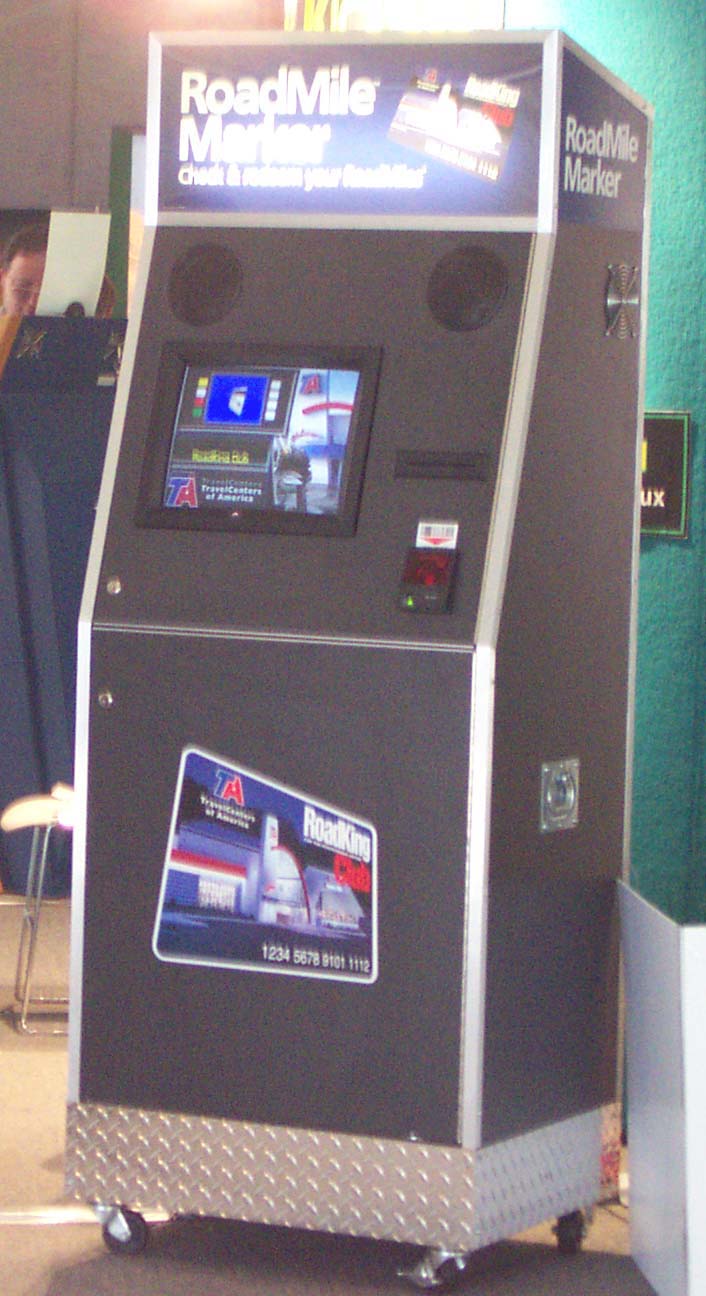 |
TravelCenters of America rewards truckers for customer loyalty with its RoadKing Club kiosks. |
"Now it's time to try some new programs, fine-tuning our logistics," he said without going into specifics. "It's now a matter of getting a direct return on investment with the program."
But the program's initial mission, to reward truckers for patronizing TravelCenter truck stops, is inherently a soft benefits deployment. And Hanzal said that part of the kiosk's mission would remain true.
TravelCenters has signed up 405,000 drivers for the RoadKing Club since launching the kiosks. The company is preparing to trade out each driver's original card with a personalized card. Drivers that swipe their current cards at the kiosk will receive information on enrolling for the new card at the kiosk. The upgrading program is being done in stages, with 50,000 truckers targeted each week.
The company is also exploring ways to generate advertising on the kiosk targeted at truckers, driving them to specific merchandise sales and meal deals at TravelCenters's in-store restaurants.
At Sheetz, the future, in a sense, is happening now. The company is banking that its sandwich shop kiosks will give Sheetz a technology credibility edge among younger customers.
"We're dealing positively with the perception of being a technological leader," Moulton said. "I hear stories and see people come in the stores, especially kids, who are excited about ordering and want to press the buttons. Hopefully, that will create excitement among our future crowds."
Related Media
Subscribe
Get the latest news and resources from Kiosk Marketplace.