Automated Retail & Kiosk Innovation Show
Transforming high-traffic operations: The power of strategic self-service
A panel of experts at the Automated Retail & Kiosk Innovation Show Dec. 10-12 will discuss how strategically deploying smart self-service solutions can elevate customer experience and unlock new revenue in high-traffic, diverse venues like airports and hospitals by focusing on user needs, strategic placement and 24/7 service quality.
December 5, 2025 by Mandy Wolf Detwiler — Editor, Networld Media Group
 ChatGPT
 Grok
Grok Perplexity
 Claude
In bustling environments where efficiency is paramount — from major airports and sprawling college campuses to critical hospitals and large event venues — the demand for quick, seamless customer interactions is growing faster than ever. This challenge, however, presents a massive opportunity: by strategically deploying self-service solutions, organizations can not only significantly elevate the customer experience but also unlock substantial new revenue streams tailored to the unique, high-volume demands of these locations.
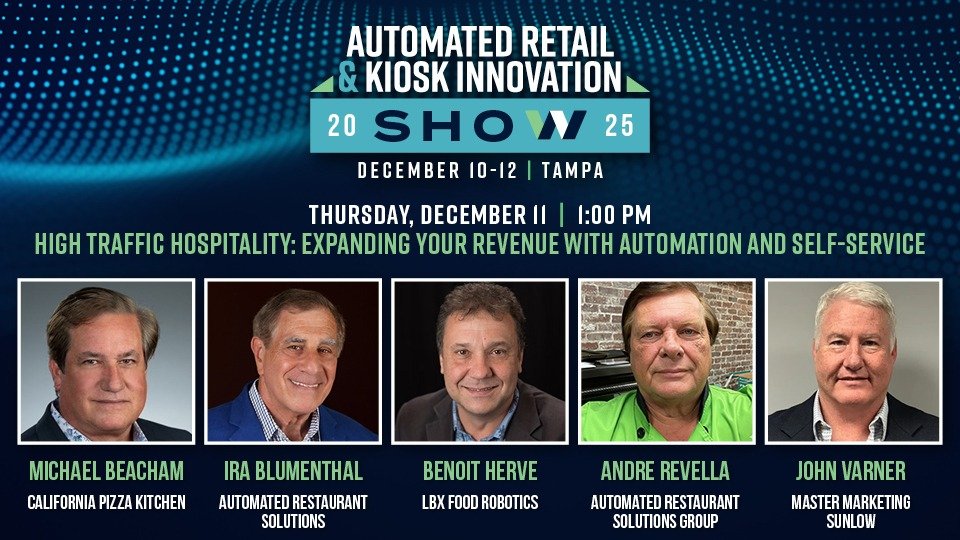
A discussion panel called "High Traffic Hospitality: Expanding Your Revenue with Automation and Self-Service" at the Automated Retail & Kiosk Innovation Show Dec. 10-12 in Tampa, Florida, looks at elevating the customer experience and driving revenue in high-traffic environments like airports, hospitals, college campus and large-scale event venues.
Speakers at the session include: Michael Beacham, president of California Pizza Kitchen, Andre Revella, culinary executive for Automated Restaurant Solutions Group, Benoit Herve, founder and CEO of session sponsor LBX Food Robotics and John Varner, partner for Master Marketing Sunlow. Ira Blumenthal, president of Automated Restaurant Solutions, which is also sponsoring the session, serves as moderator.
More than vending
This shift involves moving beyond simple vending machines to deploy integrated, smart self-service ecosystems — such as advanced wayfinding kiosks, automated check-in/checkout terminals and smart retail lockers — that handle transactions and information delivery instantly and accurately. By automating routine operations like registration, ordering and payment, staff are freed from transactional duties, allowing them to focus on high-value, complex service interactions. This strategic deployment minimizes wait times, reduces operational costs and maximizes throughput, ensuring that the critical infrastructure of airports, healthcare facilities, and entertainment centers can efficiently manage sudden surges in demand while providing a consistently high level of service 24/7.
"Confronted with intense labor challenges that are defined by both a shortage of labor and a rapidly rising minimum wage, retailers and restaurants are turning to self-service innovation as a sound, strategic way to provide efficient, effective workforce service and support of their enterprises through technology," Blumenthal said in an email interview.
High-traffic environments like airports and hospitals have wildly different user needs and operational constraints compared to a college campus or hotel.
What is most critical design or functional consideration that presenters must prioritize when developing a self-service solution that needs to be successful across such diverse locations?
"The process is very similar to placing any foodservice operation...and that is to fully understand the 'who' of the transaction," Revella said in an email interview. "In other words, 'who' is this offering for and what is an acceptable price point audience-by-audience? For instance, hospitals serve both visitors to the institution and also the vast amount of three-shift employees. Airports also have travelers passing through but also a large amount of employees support personnel work late shifts. And so, Asian might be too niche and specific while pizza is universal and attracts a wide consumer base."
Revella said the placement of kiosk and vending machines is important. The closer they are to full-service foodservice outlets, the more limited to sales due to human interactions competition.
"Placing machines in its own food desert, so to speak, is a better choice. As an example, placing a machine in an airport at the end of the terminal concourse might grab those stragglers who didn't get their food in the food court typically at the heart of the concourse. Nonetheless, locations are defined by traffic 24/7," he added.
Remember, early morning flights and late-night flights are likely not going to have adjacent food service operations open and that provides vending a huge opportunity. Another example is hospitals. Placing machines near high-traffic areas such as adjacent to elevator banks are more likely to capture opportunities than hidden in a designated food area.
In the end, poor quality will kill any location, in locations where employees are a big part of the sales picture, you will get only one shot at especially when it comes to price point, Revella said.
Ultimately, the success of self-service solutions in diverse, high-traffic venues hinges on a deep understanding of the end-user's context and a commitment to quality and accessibility regardless of the time of day. As experts like those gathering at the Automated Retail & Kiosk Innovation Show will attest, the future of efficient operation is not just about replacing human labor, but also about using technology to create "food deserts" or service gaps that traditional operations cannot fill — be it in a quiet hospital wing late at night or the far end of an airport concourse . By prioritizing universal appeal, strategic placement and reliable execution, organizations can leverage these smart ecosystems to solve labor challenges, meet the demanding pace of modern life, and consistently drive both customer satisfaction and significant new revenue across the most critical public spaces.
To register for the Automated Retail & Kiosk Innovation Show, click here.
About Mandy Wolf Detwiler

Mandy Wolf Detwiler is the managing editor at Networld Media Group and the site editor for PizzaMarketplace.com and QSRweb.com. She has more than 20 years’ experience covering food, people and places.
An award-winning print journalist, Mandy brings more than 20 years’ experience to Networld Media Group. She has spent nearly two decades covering the pizza industry, from independent pizzerias to multi-unit chains and every size business in between. Mandy has been featured on the Food Network and has won numerous awards for her coverage of the restaurant industry. She has an insatiable appetite for learning, and can tell you where to find the best slices in the country after spending 15 years traveling and eating pizza for a living.
Related Media
Subscribe
Get the latest news and resources from Kiosk Marketplace.